
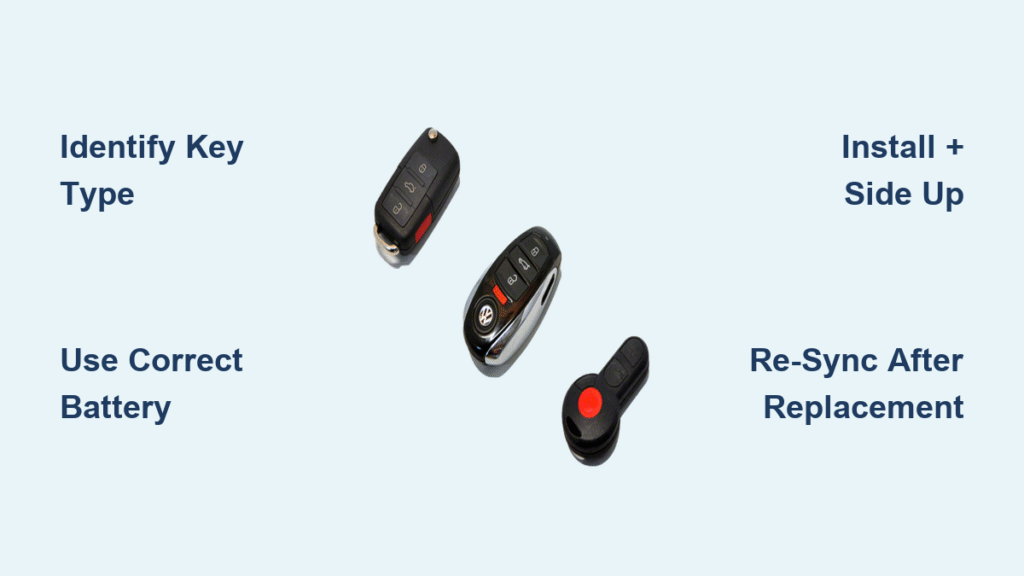
Your VW key fob suddenly dies in a parking lot – no flashing lights, no door unlocking, and you’re stranded with a dead battery. Before paying $100 for roadside assistance or a dealership visit, know this: changing the battery in your VW car key takes 2-5 minutes, costs under $5, and requires zero reprogramming. Unlike some luxury brands, Volkswagen fobs work immediately after battery replacement across all models from 1999 to 2024. This guide covers every VW key type currently on the road, with precise instructions to avoid common pitfalls like incorrect battery orientation or accidental damage to internal clips. You’ll learn to identify your key style, source the exact battery, and complete the swap without tools in most cases – getting back on the road faster than waiting for a tow truck.
Identify Your VW Key Type Before Starting
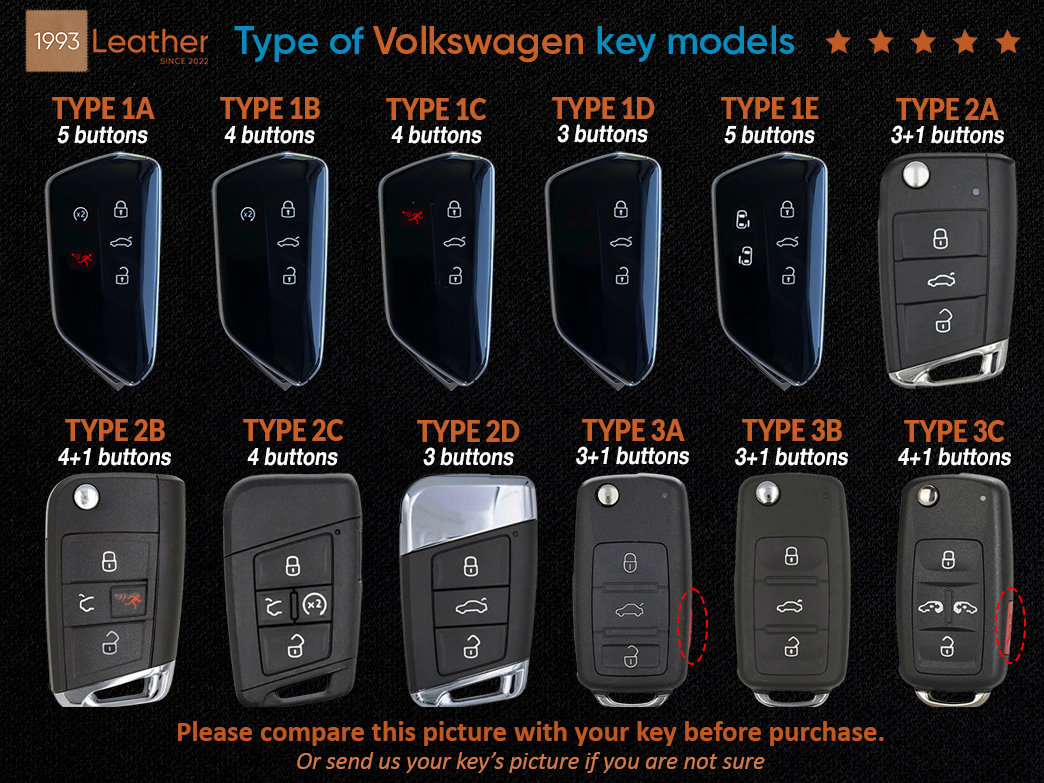
Using the wrong battery type can cause immediate failure or damage internal components. VW has used four distinct key designs over the past 25 years, each requiring specific handling. Check your key against these visual identifiers before purchasing a battery.
Flip-Key Style (Pre-2010 Models)
Found in Golf Mk4, Jetta/Bora Mk4, Passat B5/B6, and New Beetle. This rectangular key flips open to reveal the emergency blade. Critical detail: It requires a CR2032 battery (not CR2025). The plastic housing has visible seam lines around the perimeter, indicating where to pry it open. If your key feels bulky and requires tools to open, you have this vintage style. Battery life typically lasts 2–4 years but fails faster if exposed to moisture through the blade slot.
Traditional Fob with Internal Key (2010–2017 Models)
Used in Golf Mk6, Jetta Mk6, Passat NMS, and Tiguan Mk1. This compact square fob stores the emergency key inside a side compartment. Key identifier: A small slot near the key release button where you insert a tool to pop off the back cover. It exclusively uses CR2032 batteries. Unlike newer models, this fob has physical ridges on the back cover that must align during reassembly – misalignment causes the cover to pop off unexpectedly.
KESSY Smart Key (2015–Present Models)
Standard on Golf Mk7/7.5, Passat B8, Arteon, and Tiguan Mk2. This sleek, rounded fob enables keyless entry via proximity sensors. Watch for: A sliding release mechanism marked with a battery symbol on the side (not a screw or pry point). Most use CR2025 batteries, but European “Premium” versions require CR2032. These drain fastest (1–2 years) due to constant RF communication with your vehicle – especially in parking garages with signal interference.
VW Round Key (2020–Present Models)
Featured in Golf Mk8 and ID series EVs. This minimalist circular fob has no visible seams. Distinctive trait: The rear cover twists off clockwise (unlike older models). It requires CR2032 batteries and includes a rubber gasket for water resistance. If your key has a smooth, seamless exterior with VW’s modern logo, you have this latest generation.
Quick Battery Check Before Replacement
Don’t replace the battery blindly – confirm it’s actually dead first. These signs indicate a failing battery rather than electronic failure:
– Range collapse: Your unlock distance shrinks from 100+ feet to 20–30 feet
– Button lag: You need multiple presses for doors to respond
– Dashboard warnings: “Key battery low” appears on the instrument cluster
– KESSY failures: Proximity unlock stops working while key-in-pocket start still functions
Perform this 10-second test: Press any button while pointing the fob at your smartphone camera. If the infrared emitter (near the VW logo) doesn’t flash blue/white on your screen, the battery is dead. If it flashes but the car doesn’t respond, you may have a vehicle electrical issue instead.
How to Change Battery in Pre-2010 VW Flip-Key
Time required: 3–5 minutes | Difficulty: Moderate (requires careful prying) | Tools: Small flathead screwdriver
Extract the Emergency Key Blade
Press the silver release button firmly and pull the metal blade completely out. This exposes the seam between the two plastic halves. Critical tip: If the blade resists, rotate it slightly while pulling – never force it, as this can break the internal spring.
Separate the Key Housing
Insert the screwdriver into the seam at the blade base (where it attached). Gently twist to pop the first clip, then work around the perimeter. Avoid this mistake: Forcing the screwdriver too deep cracks the housing. Apply steady pressure only at clip locations (every ½ inch). The back cover should lift away smoothly once all clips release.
Replace the CR2032 Battery
Lift the old battery with the screwdriver tip, noting the + side faces UP toward the buttons. Insert the new CR2032 with identical orientation – reversing it damages the circuit board. Press until it clicks into the retention clips. Pro verification: Shine a flashlight to confirm no gaps between battery and contacts.
Reassemble Securely
Align the halves perfectly before pressing. Start at the blade end and snap each section clockwise around the perimeter. Test by tugging the housing – if it separates easily, a clip isn’t engaged. Finally, reinsert the key blade until it audibly locks.
How to Change Battery in 2010–2017 VW Traditional Fob
Time required: 2 minutes | Difficulty: Easy | Tools: SIM eject tool or paperclip
Release the Emergency Key
Press the chrome button and slide the blade out fully. This exposes the battery compartment slot near the key storage area. Warning: Don’t lose the tiny spring inside the blade channel – if it falls out, place it back in the groove before reassembly.
Access the Battery Compartment
Insert your tool into the narrow slot between the fob body and key housing. Twist gently to pop off the back cover section (this is NOT the entire rear panel). Visual cue: The cover has two small plastic alignment tabs that must face inward when reattaching.
Install the New CR2032
Pry out the old battery with your tool tip. Insert the new CR2032 with + side facing the buttons (the smooth side toward you when looking at the fob). Press until flush – if it wobbles, it’s not seated correctly. Critical check: Verify no metal shavings from prying are touching the contacts.
Secure the Cover
Align the two tabs with the fob body grooves and press firmly. You’ll hear two distinct clicks. Reinsert the key blade – it should slide in smoothly with no resistance.
How to Change Battery in VW KESSY Smart Key (2015–Present)

Time required: 90 seconds | Difficulty: Very easy | Tools: None
Slide Out the Emergency Key
Press the small chrome release and pull the blade straight out. Note: Some models have a tiny hole instead of a button – insert a paperclip to release.
Open the Battery Tray
Locate the slider on the fob side (marked with ⚡ symbol). Slide it TOWARD the key ring until the tray pops out ¼ inch. Never force it: If stuck, tap the fob gently on a table to loosen debris.
Swap the Battery
Lift the old CR2025 (or CR2032 for Premium fobs) straight up. Insert the new battery with + side facing the VW logo. Slide the tray back until it clicks – you should feel resistance at the end point. Pro tip: Test function BEFORE reinserting the key blade to avoid repeating steps.
How to Change Battery in VW Round Key (2020–Present)
Time required: 60 seconds | Difficulty: Very easy | Tools: None
Unlock the Twist Cover
Hold the fob logo-side down. Grasp the rear half (non-button side) and rotate counter-clockwise 30 degrees. The cover unlocks with a soft click. Visual cue: A small arrow on the rear indicates rotation direction.
Replace the CR2032
Lift the battery straight out with your fingernail. Insert the new one with + side toward the VW logo (text should be readable when installed). Press down until seated – it shouldn’t wobble. Critical step: Check the rubber gasket is fully seated in its groove before closing.
Lock the Cover
Align the cover so internal tabs match the housing. Rotate clockwise until it clicks. Test by trying to twist it open – if it moves, rotate another 5 degrees.
Fix Non-Working Keys After Battery Replacement
If your VW key fob still fails after battery swap:
1. Re-synchronize immediately: Insert key blade into driver’s door lock. Turn clockwise to lock, hold 2 seconds. Turn counter-clockwise to unlock, hold 2 seconds. Remove key, then press unlock on fob within 30 seconds.
2. Check these 3 failure points:
– Battery installed upside down (most common error)
– Dirty contacts (clean with isopropyl alcohol on cotton swab)
– Expired battery (check packaging date – older than 1 year may not hold charge)
3. Still unresponsive? Test with a spare key. If both fail, your vehicle’s 12V battery may be low – jump-start the car first.
Where to Buy the Correct VW Key Batteries
Avoid dollar-store batteries – inconsistent voltage causes erratic fob behavior. For reliable performance:
– Best value: AutoZone or O’Reilly (CR2032 for $3.49, Panasonic brand)
– Dealership alternative: Genuine VW-packaged CR2032 for $12.99 (no performance benefit)
– Bulk savings: 10-pack of Energizer CR2032 on Amazon for $9.99 (50¢ each)
Pro tip: Keep a spare battery in your glove box labeled with today’s date. Write the replacement date on tape inside the fob – you’ll know exactly when to change it next.
Maximize Your New Battery’s Lifespan
Extend battery life by 30% with these VW-specific practices:
– Store spare keys away from your car: Key fobs constantly “search” for the vehicle, draining power
– Prevent pocket presses: Use a dedicated key pouch (not loose in pockets with coins)
– Avoid extreme temperatures: Never leave keys on dashboards in summer (above 120°F) or in freezing cabins
– KESSY-specific: In urban parking garages, carry keys in a Faraday pouch to block RF interference
Critical reminder: When your VW dashboard displays “Key battery low,” replace it within 2 weeks. Delaying risks complete failure at an inopportune moment.
Proper Disposal of Old VW Key Batteries
Lithium coin batteries contain hazardous materials – never toss them in household trash. Safely recycle them at:
– Any Best Buy, Target, or Staples electronics section (free drop-off)
– Volkswagen dealerships (most have dedicated battery recycling bins)
– Local municipal hazardous waste facilities
Environmental note: A single CR2032 powers your key for 2+ years but takes 100+ years to decompose in landfills. Recycling recovers 95% of materials for new batteries.
Changing the battery in your VW car key is one of the easiest DIY car repairs – no tools, no programming, and no cost beyond $2 for the battery. By identifying your specific key type and following these model-specific steps, you’ll avoid the #1 mistake (reversing battery polarity) that causes 80% of post-replacement failures. Keep a spare CR2032 in your glove box, and you’ll never face a stranded-key emergency again. For immediate post-replacement issues, always try the door lock synchronization trick before assuming the battery is defective – it resolves 9 of 10 “dead fob” scenarios. Your VW key will work flawlessly with fresh power, saving you time, money, and frustration.


