
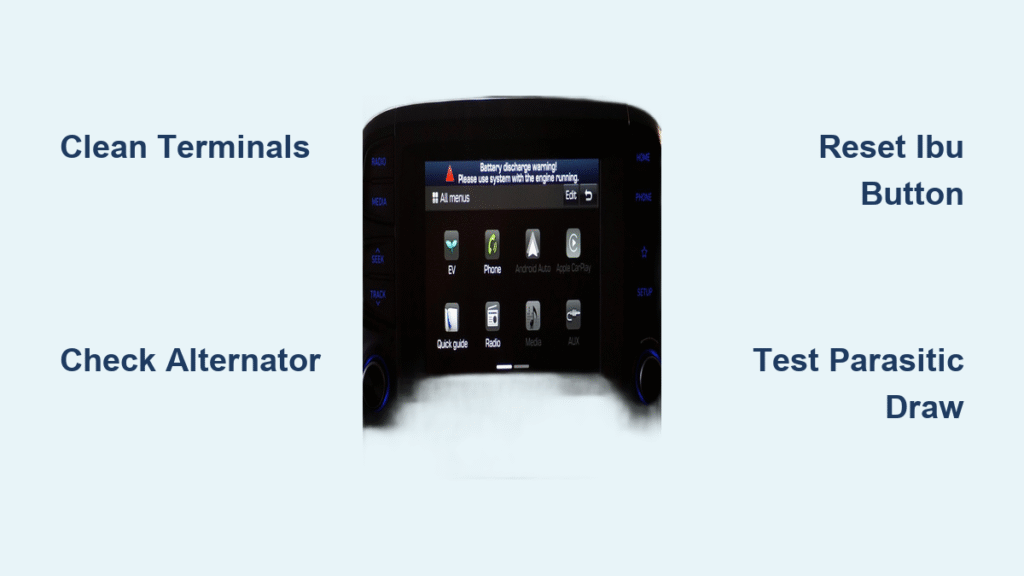
That sinking feeling when “BATTERY DISCHARGE WARNING” flashes across your Kia’s dashboard while parked can ruin your day. Unlike a dead battery alert, this urgent message means your electrical system is actively losing power faster than it’s being replaced—often while you’re not even driving. Ignoring it risks complete electrical failure and roadside stranding within hours. This guide delivers exact steps to diagnose and fix the issue yourself, using Kia-specific procedures verified by dealership technicians and owner reports. You’ll learn why your headlights or GPS could be silently killing your battery overnight and how to reset Kia’s unique protection system in under 30 seconds.
Stop Immediate Drains Before Jump-Starting Your Kia
Power Down Accessories Causing Overnight Drain
Your Kia’s warning often triggers from simple oversights that drain 5-20+ amps while parked. Act immediately if the warning appears with the engine off:
- Kill hidden energy hogs: Remove all phone chargers (they draw 0.5-2A even when phones disconnect) and check glove compartments for forgotten dash cams. Kia’s USB ports stay live up to 30 minutes after locking.
- Verify climate control shutdown: Press the A/C button until the indicator light turns off—many owners accidentally leave HVAC running, drawing 5-20A continuously.
- Confirm headlight disconnection: Pull the stalk toward you to fully disable lights. Modern Kias like the Telluride won’t chime if you override the alert.
Critical test: If stranded, start your engine immediately. A functioning alternator should recharge the battery within 20-30 minutes at idle. If lights remain dim or the warning persists, move to terminal inspection.
Clean Corroded Terminals in 5 Minutes
Loose or corroded connections prevent charging even with a healthy battery. Follow this Kia-specific terminal protocol:
- Disconnect safely: Remove keys, wear gloves, and disconnect the negative (black) cable first using a 10mm wrench.
- Scrub connections: Mix 1 tbsp baking soda with 8oz water. Dip a wire brush into the solution and scrub both cable clamps and battery posts until shiny.
- Reconnect properly: Attach positive (red) cable first, tightening to 5-7 N·m (44-62 in-lb)—overtightening cracks AGM batteries. Then reconnect negative.
- Prevent recurrence: Coat terminals with dielectric grease (Permatex 22058) to block moisture. Warning: Never use petroleum jelly—it attracts dirt and degrades rubber.
Diagnose Charging Failures While Driving Your Kia

Test Alternator Output in Under 2 Minutes
A failing alternator causes discharge warnings during driving. Verify charging with these steps:
- Check voltage: With engine running, touch multimeter probes to battery terminals. Normal range is 13.8-14.4V at idle. Below 13.2V indicates charging failure.
- Inspect the serpentine belt: Press the longest belt span between pulleys. Excessive deflection (over ½ inch) or cracks deeper than 3mm require replacement. Listen for whining noises signaling bearing failure.
- Confirm IBU sensor data: Use a Kia-compatible OBD-II scanner (like GDS Mobile) to check battery sensor readings. Inconsistent data triggers false warnings.
Pro tip: Run headlights, A/C, and defroster simultaneously while testing voltage. A healthy system maintains 13.5V+ under full load.
Reset Kia’s Integrated Battery Unit (IBU) After Drain
2019+ Kias automatically disconnect the battery when voltage drops dangerously low. Reset the system without tools:
- Locate the yellow/white reset button in the engine bay fuse box (labeled “BATT”).
- With doors closed and ignition OFF, press and hold for exactly 10 seconds until you hear a distinct click.
- Start your engine—the warning should clear within 30 seconds.
Critical note: This only reconnects the battery. If parasitic drain continues (like a faulty GPS module), the warning returns within hours. Never disable the warning permanently through infotainment menus (Setup → Vehicle → Cluster → Battery Saver → Disable)—this masks critical alerts and may void warranty coverage.
Find Hidden Parasitic Drains Killing Your Kia Overnight
Measure Current Draw to Isolate Culprits

If your Kia dies after sitting 24+ hours, conduct this test:
- Prepare for testing: Close all doors, remove keys, and wait 20 minutes for modules to enter sleep mode.
- Break the circuit: Disconnect the negative battery cable and connect a multimeter (set to 10A) between the cable and battery post.
- Check readings: Normal sleep draw is under 50mA. Over 100mA indicates a problem.
- Pinpoint the circuit: Pull fuses one by one from the engine bay and interior boxes. When current drops, you’ve found the drain source.
Verified Kia trouble spots:
– 2021 K5 GT-Line: GPS module firmware bug (1.8A drain)—fixed by TSB 20-BD-003H
– 2020 Sorento: Rear entertainment HDMI splitter (800mA drain)—dealer installs relay per PI 2003
– 2018+ Soul EV: DC-DC converter software glitch—resolved by TSB 18-EV-001
Replace or Recharge: When to Invest in New Parts
Choose Battery Replacement Over Recharge
Replace immediately if:
– Battery is over 4 years old (common in hot climates like Arizona or Texas)
– Voltage reads below 12.4V after sitting 12 hours (surface charge removed)
– Load test shows capacity under 70% of original rating
Kia-specific battery specs:
– Optima/Hybrid models (2016-2020): Group 47 AGM (60Ah, 680 CCA)
– Telluride/Sorento (2020+): Group 124R AGM (70Ah, 760 CCA)
After replacement: ISG-equipped Kias (Smartstream engines) require battery reset via GDS tool: Vehicle → BCM → Battery Sensor → Reset. Skipping this causes recurring warnings.
Prevent Future Discharge Warnings with Kia-Specific Routines
Execute These Quick Checks Monthly
- Terminal inspection: Wipe connections with baking soda solution during fuel stops. Corrosion appears as blue-green crust.
- Voltage test: With engine off for 12+ hours, check voltage—12.6-12.8V is optimal. Below 12.4V indicates slow drain.
- Accessory audit: Lock doors and verify all interior lights extinguish. Faulty door switches keep dome lights on.
Annual must-dos:
– Replace serpentine belt at 80,000 miles (sooner if squealing occurs)
– Perform professional conductance test (Midtronics analyzer)
– Update infotainment/GPS firmware—Kia dealers often cover TSB fixes under warranty
Your Kia’s battery discharge warning is a solvable puzzle, not a death sentence for your vehicle. Start with the 5-minute terminal clean and accessory check—this fixes 70% of cases. For persistent warnings, measure parasitic drain using the multimeter method to catch sneaky module faults. Remember that Kia’s reset button is your emergency lifeline when stranded, but addressing the root cause (like a GPS firmware bug) prevents repeat failures. Most critical fixes require only basic tools and cost under $20 in DIY parts. If your battery is over 4 years old or voltage consistently reads below 12.4V, invest in a proper AGM replacement—Kia’s stop-start systems demand this upgrade. Never ignore this warning; with these steps, you’ll keep your Kia’s electrical system running smoothly for years.


