
Your car sits dead after just two days of inactivity, yet the battery tested strong last week. This maddening scenario almost always points to parasitic drain—a hidden electrical current bleeding power while your vehicle sleeps. Modern cars need some current for memory functions, but anything exceeding 50-100 milliamps will leave you stranded. This guide delivers proven techniques to hunt down these electrical vampires, from basic multimeter testing to professional diagnostic methods. You’ll learn exactly how to measure abnormal drain, isolate culprit circuits, and eliminate the problem for good—saving costly battery replacements and roadside emergencies.
Normal vs. Abnormal Battery Drain: What Your Numbers Mean
Modern vehicles maintain essential functions through controlled current draw when parked. Most post-1990 models draw 20-50 milliamps for clock memory and alarm systems, while luxury vehicles with telematics may reach 70-90 milliamps. Anything above 100 milliamps becomes dangerous—draining a standard 74 amp-hour battery completely within three days. Recognizing acceptable versus problematic drain prevents wasted troubleshooting time.
Real-World Drain Benchmarks by Vehicle Type
Compare these actual measurements to your readings: A 1998 Jaguar XJR shows dramatic progression—from 3.7 amps immediately after shutdown (doors open) down to 47 milliamps once fully asleep with all compartments sealed. Meanwhile, a 1998 Jeep Cherokee maintains a healthy 26-milliamp draw but jumps to 1 amp if the key remains in ACC position. Aftermarket accessories like miswired Parrot Bluetooth kits can add 400+ milliamps when connected to constant 12V instead of ignition-switched circuits.
Red Flags Indicating Serious Parasitic Drain
Watch for these critical warning signs: Your battery voltage dropping below 12.4V after 24 hours of inactivity, interior lights failing to illuminate when opening doors after parking, or recurring “low battery” warnings on the dashboard. If your multimeter shows over 100 milliamps after the 10-45 minute sleep period, you’ve confirmed abnormal drain requiring immediate investigation.
Essential Tools for Accurate Parasitic Drain Testing

You can’t diagnose electrical gremlins with basic tools. A digital multimeter with 10-amp DC fused input and precise milliamp range is non-negotiable—cheap meters lack the necessary accuracy below 500mA. Always include fuse pullers and your vehicle’s specific fuse diagram; guessing fuse locations wastes hours during critical testing windows.
Must-Have Multimeter Settings and Safety Gear
Configure your meter correctly before connecting: Insert black lead into COM jack, red lead into 10A port, and set dial to DC amps. Never skip safety glasses and insulated gloves—accidental short circuits near battery terminals can cause explosive sparks. Critical mistake: Starting the engine with meter leads in mA mode will instantly destroy your multimeter’s internal fuse. Always verify current is below 400mA before switching to the sensitive mA range.
Professional Upgrades for Intermittent Drains
For ghost drains that disappear during testing, invest in a current clamp for non-intrusive cable measurements. Data-logging multimeters capture overnight fluctuations that standard meters miss. A simple OBD-II memory saver ($20) prevents radio code lockouts and module resets when disconnecting the battery—worth every penny during repeated tests.
Critical Pre-Test Checks to Avoid False Alarms
Battery issues often masquerade as parasitic drain. Before connecting your meter, fully charge the battery to 12.6 volts and perform a professional load test. A weak battery with reduced capacity will “die” faster even with normal drain—wasting hours chasing non-existent problems. Similarly, verify alternator output reaches 13.8-14.4 volts during engine operation; low charging creates false drain symptoms.
Eliminating Obvious Power Hogs Before Testing
Conduct a thorough visual inspection: Check glovebox, trunk, and vanity mirror lights for proper shutoff. Remove all OBD-II dongles, dash cams, and phone chargers—these common accessories often draw 100-200mA continuously. Pro tip: Use your smartphone camera in video mode to record interior lights while closing doors—this reveals slow-shutoff issues invisible to the naked eye.
Achieving True Sleep Mode: The 45-Minute Rule
Modern vehicles require complete isolation to enter sleep mode. After locking the car, ensure key fobs stay 15+ feet away—some systems wake within 5 feet. Tape door jamb switches closed using painter’s tape to simulate fully closed compartments; manually wedging switches avoids accidental module wake-ups during fuse testing. Never skip the mandatory 10-45 minute wait period—manufacturer-specific sleeping sequences complete during this window.
Door Switch Hacks to Prevent Module Wake-Ups
For cars with hood/trunk sensors, place foam blocks against latch mechanisms to simulate closure without actually shutting compartments. This allows fuse box access while maintaining “sleep” status. Opening any door—even briefly—resets the entire module network, forcing you to restart the 45-minute countdown. Critical mistake: Pulling fuses before modules sleep shows falsely high readings of 500mA-2A as systems reboot.
Series Current Measurement Without Blowing Your Meter
Always disconnect the negative battery cable first—removing positive risks catastrophic short circuits against grounded chassis parts. Create your measurement circuit by connecting multimeter leads: Red probe to battery negative post, black probe to the disconnected negative cable. This forces all vehicle current through your meter for accurate readings.
Interpreting Initial Amp Spikes and Sleep Current
Expect 0.5-3 amps for the first 30 seconds as retained accessory power shuts down. Healthy systems then drop steadily toward quiescent levels. If readings stay above 400mA after 2 minutes, remain on the 10A range. Only switch to the mA jack when current falls below 400mA for precise measurement. Below 50mA is normal; 50-100mA warrants monitoring; over 100mA confirms parasitic drain requiring immediate action.
Pinpointing the Drain: Fuse Pulling vs. Voltage Drop
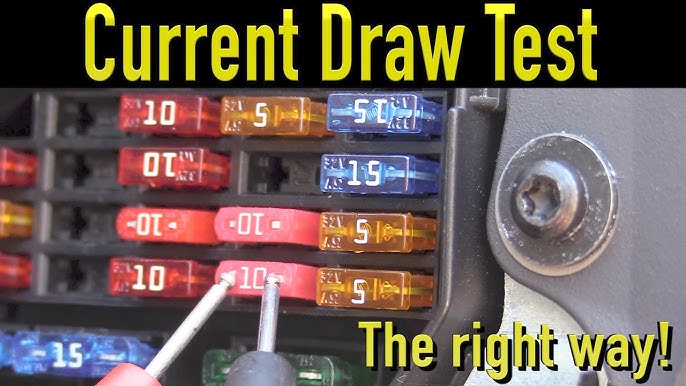
With abnormal drain confirmed, isolate circuits using the pull-fuse method. Maintain meter connection while systematically removing fuses from all boxes—under-hood and interior. Watch for sudden current drops: A 250mA reading falling to 30mA when pulling fuse #22 identifies that circuit as the culprit. Immediately document the fuse number and circuit description before reinserting it.
Fuse Removal Technique That Won’t Reset ECUs
Work methodically through fuse boxes while keeping door switches taped closed. For modern cars, the voltage-drop method avoids waking modules entirely. Set your meter to millivolts DC and probe both sides of each fuse. Convert readings using this mini-fuse chart: 5A fuse showing 7.32mV = 1 amp; 10A fuse at 3.65mV = 1 amp. This non-intrusive screening identifies problem circuits without resetting critical ECUs.
Top 5 Parasitic Drain Culprits and How to Confirm Them

Aftermarket stereos and amplifiers top the offender list—often wired directly to constant 12V instead of ignition-switched circuits. Check for displays staying lit or retained presets overnight. Similarly, Bluetooth kits like Parrot draw 200-600mA when miswired. Confirm by temporarily disconnecting the accessory; if drain drops to normal, you’ve found your culprit.
Trunk Light Failures That Drain Batteries Overnight
Stuck trunk or glovebox lights commonly draw 300-700mA. Verify shutoff using your smartphone video trick during door closure. If the light remains illuminated, replace the faulty switch or adjust the latch mechanism. Pro tip: Place a small piece of reflective tape on the trunk lid—this makes light bleed visible during nighttime inspections.
Solving Non-Fused Circuit and Intermittent Drains
Direct battery feeds like starter cables or alternator sense wires lack cabin fuses, requiring alternative diagnosis. Use your current clamp on large cables while monitoring for unexpected warmth—indicating current flow where none should exist. For intermittent drains, connect a data-logging multimeter overnight; sudden spikes at 3AM reveal timers or security systems gone rogue.
Overnight Data Logging for Ghost Drains
Install a parasitic draw test switch between battery and cable for extended monitoring. This specialized tool contains a built-in shunt that maintains circuit integrity while logging current. Review the 24-hour graph to identify patterns—like a 200mA spike every 4 hours indicating a faulty control module cycling unnecessarily.
Post-Repair Verification: Ensuring Your Fix Worked
After repairing the faulty circuit—whether rewiring an accessory or replacing a stuck relay—reconnect the battery (negative cable last) and repeat the full sleep cycle test. Verify current drops below 50mA after the mandatory 45-minute wait period. Never skip the 24-hour battery voltage check: Measure at 12.6V before parking, then confirm it remains above 12.4V after 24 hours.
Test Drive Checks to Prevent Future Issues
Take a 20-minute drive after repairs to validate charging system operation. Monitor dashboard for unexpected warning lights that may indicate ECU conflicts from improper reconnection. Confirm all accessories function normally—especially keyless entry and radio presets—to ensure no modules were damaged during testing.
Safety Landmines: What Never to Do During Testing
Never attempt to start your engine with the multimeter connected in series—the 100+ amp surge will vaporize your meter’s internal fuse and potentially cause electrical fire. Always disconnect the meter before engine operation. Similarly, never pull fuses while holding metal tools near grounded surfaces; a single slip can create a dead-short across battery terminals.
Memory Saver Tricks to Avoid Radio Code Lockouts
Prevent frustrating radio resets by using an OBD-II memory saver plugged into your diagnostic port before disconnecting the battery. This $20 device maintains 12V power to critical modules using a 9V battery. For older vehicles without OBD-II, connect a dedicated memory saver directly to cigarette lighter ports—but verify it won’t introduce its own parasitic drain during testing.
Final verification is your ultimate safety net: After completing repairs, conduct a 72-hour observation period with your multimeter connected. True parasitic drain solutions show consistent readings below 50mA through multiple sleep cycles. Master these techniques, and you’ll transform from frustrated owner to confident electrical detective—diagnosing what dealers often miss while saving hundreds in unnecessary battery and towing costs. Remember: Patience during the sleep cycle wait separates successful fixes from wasted weekends, and that 45-minute timer is your most important tool.