
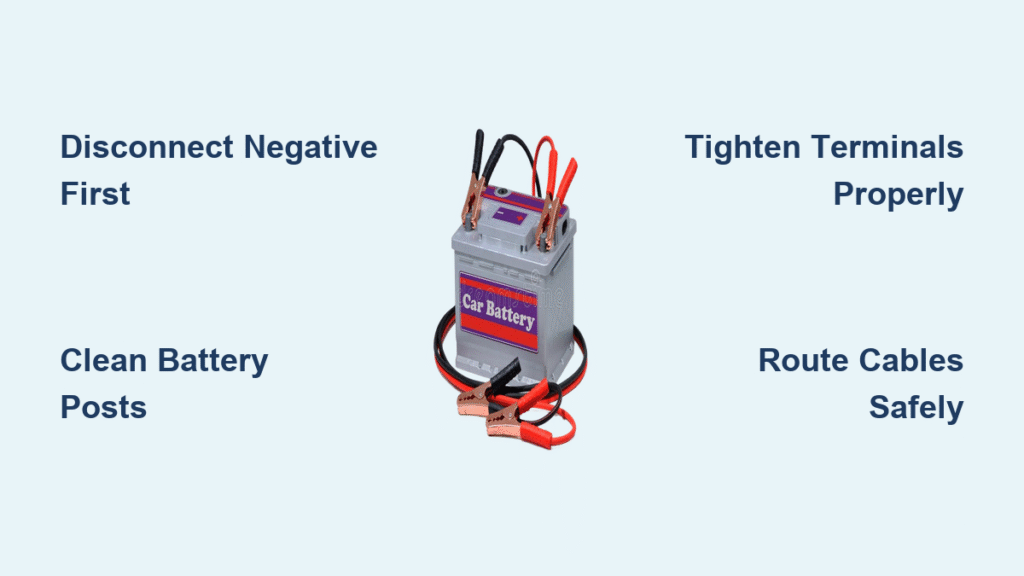
Your engine clicks but won’t start. The lights dim when you turn the key. These frustrating moments often trace back to worn battery cables that can’t deliver the power your car needs. Learning how to install car battery cables yourself saves you from expensive shop visits and gets you back on the road quickly. This essential repair takes less than thirty minutes with basic tools and can prevent being stranded with a dead electrical system.
This guide walks you through every step of replacing battery cables safely and correctly. You’ll learn which symptoms signal cable failure, the exact tools you need, and a foolproof installation process that prevents common mistakes. Whether you’re dealing with corrosion, frayed wires, or complete cable replacement, these practical steps restore reliable power to your vehicle. Mastering this skill gives you confidence during roadside emergencies and extends your battery’s lifespan through proper maintenance.
Warning Signs Your Battery Cables Need Replacement
Critical Failure Indicators
- Slow engine cranking that gets progressively worse despite a healthy battery
- Intermittent no-start conditions that appear random but follow temperature changes
- Visible insulation damage like cracks, melted spots, or exposed copper strands
- Persistent corrosion that returns within weeks after thorough cleaning
- Physical terminal damage where copper strands break or connectors pull away
Quick Field Diagnosis Method
Gently flex each cable along its entire length. Healthy cables feel supple with no crunching sounds. If you hear crackling or the cable feels stiff like a straw, internal corrosion has compromised the wire strands. Green or white crusty buildup extending under the insulation indicates replacement is necessary—cleaning won’t solve this problem.
Essential Safety Steps Before Cable Replacement
Non-Negotiable Safety Protocol
- Always disconnect negative first – this breaks the circuit and prevents dangerous short circuits
- Remove all jewelry – rings and watches can create electrical bridges causing burns
- Work on cool engine components – hot parts increase risk of acid burns
- Ensure proper ventilation – battery gases are explosive in confined spaces
- Wear chemical-resistant gloves and safety goggles – battery acid causes severe burns
Tool Handling Safety
Keep metal tools away from both battery posts simultaneously. One accidental slip can create massive sparks, permanently damage your battery, or even cause an explosion. Place tools on a clean rag away from the battery when not in use. Never set tools on the engine block where they might roll toward the battery.
Required Tools for Proper Cable Installation

Basic Tool Kit for Most Vehicles
- Wrench set: 8mm, 10mm, 13mm most common sizes
- Brass wire brush: Specifically designed for battery corrosion removal
- Electrical contact cleaner: Spray formula for thorough post cleaning
- Dielectric grease: Prevents future corrosion on contact surfaces
Essential Replacement Parts
- Positive cable: Red insulation, matches original length and wire gauge
- Negative cable: Black insulation, ensure proper ground connection point
- Terminal ends: Universal clamp-on or OEM-style ring terminals
- Corrosion protection: Felt pads and anti-corrosion spray
Professional-Grade Tools (Optional)
- Torque wrench: Ensures proper terminal tightness without damaging lead posts
- Cable crimper: For custom length cables with secure connections
- Soldering kit: Creates permanent, high-conductivity terminal connections
Proper Sequence for Removing Old Battery Cables
Critical Disconnection Order
- Locate terminals – positive (+) usually has red cover or marking
- Loosen negative clamp – turn counterclockwise until about 8-10mm loose
- Remove negative cable – wiggle upward while pulling straight off
- Secure negative cable – tuck away so it cannot spring back to battery
- Repeat for positive – same process, but never let metal tools touch both posts
Battery Removal for Better Access
For tight engine compartments, remove the battery entirely. Loosen the hold-down bracket (typically two 10mm bolts), then lift straight up while keeping the battery level. Remember that batteries contain acid—spills damage paint and clothing permanently. Set the battery on a clean, flat surface away from tools.
Thorough Cable Inspection and Cleaning Process
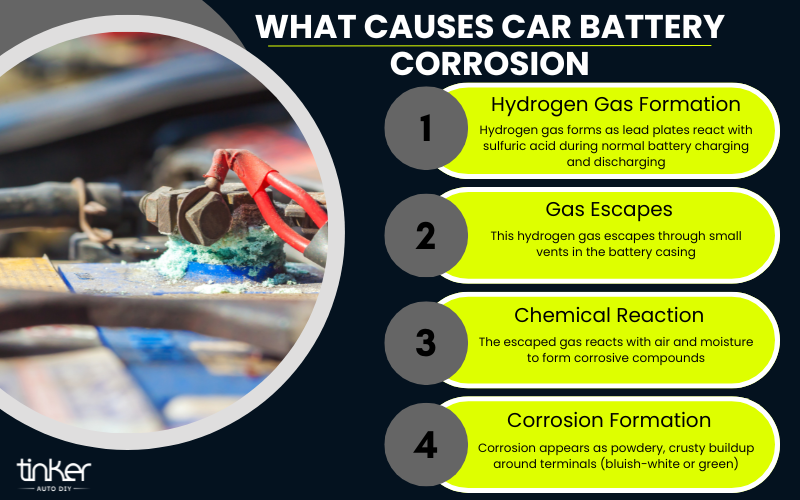
Comprehensive Cable Evaluation
Trace each cable from battery to its final connection point. Look for:
– Green wicking under insulation indicating deep internal corrosion
– Heat damage near exhaust components showing melted insulation
– Chafing points where cables rub against sharp metal edges
– Broken strands concentrated at terminal connections
Professional-Grade Cleaning Method
Use a brass wire brush to polish battery posts until they shine like new lead. Clean inside terminal clamps until all corrosion disappears. Spray electrical contact cleaner liberally and let dry completely. Apply a thin, even coating of dielectric grease to all contact surfaces before reassembly—this simple step prevents 90% of future corrosion issues.
Correct Installation of New Battery Cables

Optimal Cable Routing Technique
Route replacement cables along the original factory path using existing clips. Keep cables away from:
– Hot exhaust manifolds that can melt insulation
– Moving steering components that cause chafing
– Sharp metal edges that wear through protective covering
Critical Connection Sequence
- Attach positive cable to starter motor or distribution block first
- Connect positive to battery – ensure full seating with no gaps
- Attach negative cable to chassis ground point (usually inner fender)
- Connect negative to battery – this should always be your final connection
Proper Terminal Tightening Procedure
Tighten terminals until snug—approximately 5-7 N·m (45-65 in-lb). Over-tightening deforms soft lead posts and creates loose connections over time. Terminals should not move when you try to wiggle them. If you have a torque wrench, use it—this prevents costly damage to battery posts.
How to Replace Just Terminals Instead of Full Cables
When Terminal Replacement Makes Sense
If corrosion stops within 6-8 inches of the terminal, you can save money by replacing only the terminal end. This works when the cable itself remains flexible with no crunching sound when bent. Many DIYers don’t realize this option exists and pay for unnecessary full cable replacements.
Step-by-Step Terminal Installation
- Cut old terminal leaving maximum cable length intact
- Strip 1/2 inch insulation cleanly from cable end
- Insert into new terminal ensuring full copper contact
- Crimp securely – add solder for permanent connection
- Slide protective boot over new terminal before installation
Verifying Your Cable Installation Works
Immediate Functionality Check
Start the engine—it should crank quickly without hesitation. Check that headlights maintain full brightness during cranking. Any dimming or slow cranking indicates loose connections somewhere in the system. If you hear clicking without cranking, double-check your terminal tightness.
Professional Performance Verification
After 5 minutes of running, carefully feel each connection point. Warm is normal, but hot terminals signal poor contact that needs immediate correction. Use a multimeter to check voltage drop across each cable—should be less than 0.3 volts. Higher readings indicate resistance problems requiring re-cleaning or replacement.
Fixing Common Post-Installation Problems
Troubleshooting Table for Immediate Issues
| Symptom | Likely Cause | Solution |
|---|---|---|
| Slow crank | Loose connection | Retighten all terminals to proper torque |
| Click but no start | Poor ground connection | Clean ground point on chassis |
| Repeated corrosion | Overcharging battery | Test charging system voltage |
| Melted insulation | Cable too close to exhaust | Reroute with heat shield protection |
Expert Diagnostic Tip
If problems persist after cable replacement, check your battery’s health and the alternator’s charging voltage. A failing battery that overcharges can damage new cables through excessive heat and corrosion. Test your charging system—it should read 13.8-14.4 volts with engine running.
Cost-Saving Strategies for Battery Cable Replacement
DIY vs Professional Pricing Comparison
- DIY full cable set: $30-80 for quality replacement cables
- Shop labor for terminal replacement: $50-200 for similar work
- Full cable replacement at shop: $150-400 including parts and labor
- Dealer OEM harness: $200-1000 for factory cable assemblies
Smart Shopping Tips
Buy aftermarket cables that match your vehicle’s specifications exactly. Universal cables work for most applications and cost 60% less than OEM parts. Always compare wire gauge specifications—thicker cables handle more current and last longer. Check online retailers for better prices than local auto stores.
Essential Post-Installation Maintenance
Preventive Care Schedule
- Monthly: Quick visual inspection for early corrosion signs
- Every oil change: Check terminal tightness and cable routing
- Annually: Complete terminal cleaning and dielectric grease reapplication
Properly maintained cables last 5-7 years. The key is catching minor corrosion early before it penetrates insulation. Keep a small container of dielectric grease in your glove compartment for quick touch-ups during routine checks.
Mastering how to install car battery cables transforms a frustrating breakdown into a manageable repair you can complete during lunch break. Your car now delivers reliable starting power, and you’ve gained valuable automotive skills that save hundreds in service costs. Schedule quarterly cable inspections to catch problems early, and keep dielectric grease handy for quick maintenance touch-ups. With proper care, your new cables will provide years of dependable service—until next time you hear that confident engine roar on the first try.


