
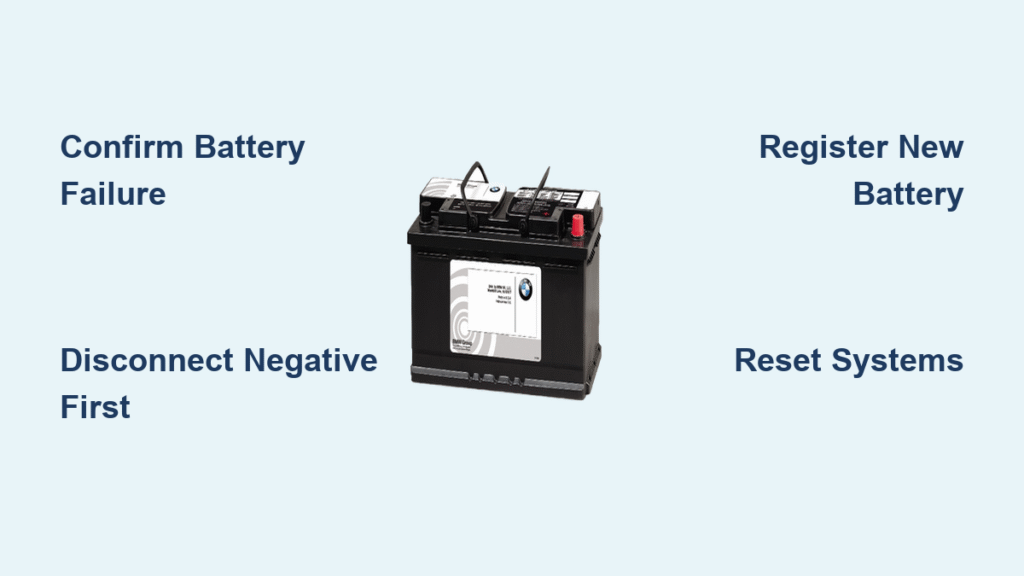
Your BMW cranks sluggishly on cold mornings, the iDrive flashes “Increased battery discharge,” and the dealer quoted $520 for a new battery plus labor. Stop right there—this isn’t a dealership-only job. With basic hand tools and 45 minutes, you can swap your BMW’s 12V battery yourself and keep that cash in your pocket. This guide cuts through the complexity, showing you exactly how to replace BMW car battery safely while avoiding costly registration mistakes that trigger warning lights days later. You’ll learn to verify if the battery is truly dead, locate hidden components, and register the new unit properly—no prior mechanical skills needed.
Most BMW owners don’t realize their vehicle’s computer actively manages battery charging. Skip the registration step after replacement, and you’ll face recurring warnings and premature failure—even with a brand-new AGM battery. By following this process, you’ll not only solve the immediate no-start issue but also prevent future electrical gremlins. Let’s get your BMW starting strong again without unnecessary service center visits.
Confirm Your BMW Battery Actually Needs Replacement
Spot True Failure vs. Parasitic Drain
Don’t jump straight to replacement—50% of “dead battery” cases stem from parasitic drains. Before buying a new unit, verify sleep mode: Close all doors, lock the car, and wait 15–30 minutes. The hazard lights and start/stop button must go completely dark. If anything stays illuminated (like a dome light), your battery is being drained by an accessory left on, a faulty module, or aftermarket device like a dash cam. A multimeter test showing voltage below 12.4V after full rest confirms battery failure—not just a temporary drain.
Check Expected Battery Lifespan First
OEM and quality AGM batteries last 5–6 years in BMWs. If yours failed sooner, replacement might be premature. Sudden death in a 2-year-old battery often points to alternator issues or chronic parasitic drain. Note cold-weather cranking hesitation—it’s a classic sign of degradation even if the battery still starts the car. But if a new battery dies within days, immediately suspect alternator malfunction (check for 13.5–14.8V charging) or a parasitic draw exceeding 50mA.
Gather Critical Safety Gear and Tools

Non-Negotiable Safety Precautions
Skip safety steps, and you risk electrical shorts or acid burns. Always wear rubber safety gloves and safety glasses before touching terminals. Remove all metal jewelry—watches or rings can cause dangerous arcing if they contact both terminals. Work in a well-ventilated area (outside or open garage) to disperse hydrogen gas. Never allow tools to bridge positive and negative terminals; a single slip can melt metal and fry control modules.
Exact Tools Needed for BMW Battery Swap
| Tool | Purpose | Critical Detail |
|---|---|---|
| 10mm socket & ratchet | Disconnect terminals | Use a 6-point socket to avoid rounding nuts |
| 13mm socket (or ½”) | Remove hold-down bracket | Extension required for bottom bolts on most models |
| Flathead screwdriver | Release power-distribution box | Gently pry clips to avoid breaking plastic |
| Terminal brush + anti-corrosion gel | Clean posts | Prevents voltage drop from corrosion |
| Zip-ties | Secure negative cable | Isolate it during removal to prevent contact |
Pro Tip: Keep shop towels under terminals to catch acid drips. Buy an OEM-spec AGM battery matching your model’s Ah rating (typically 70–95Ah) and group size (H6/H7/H8). Aftermarket units cost $80–$120 plus a $12 core refund—just verify dimensions first. A taller case can hit the trunk floor and crack.
Access Trunk-Mounted Battery Without Damage
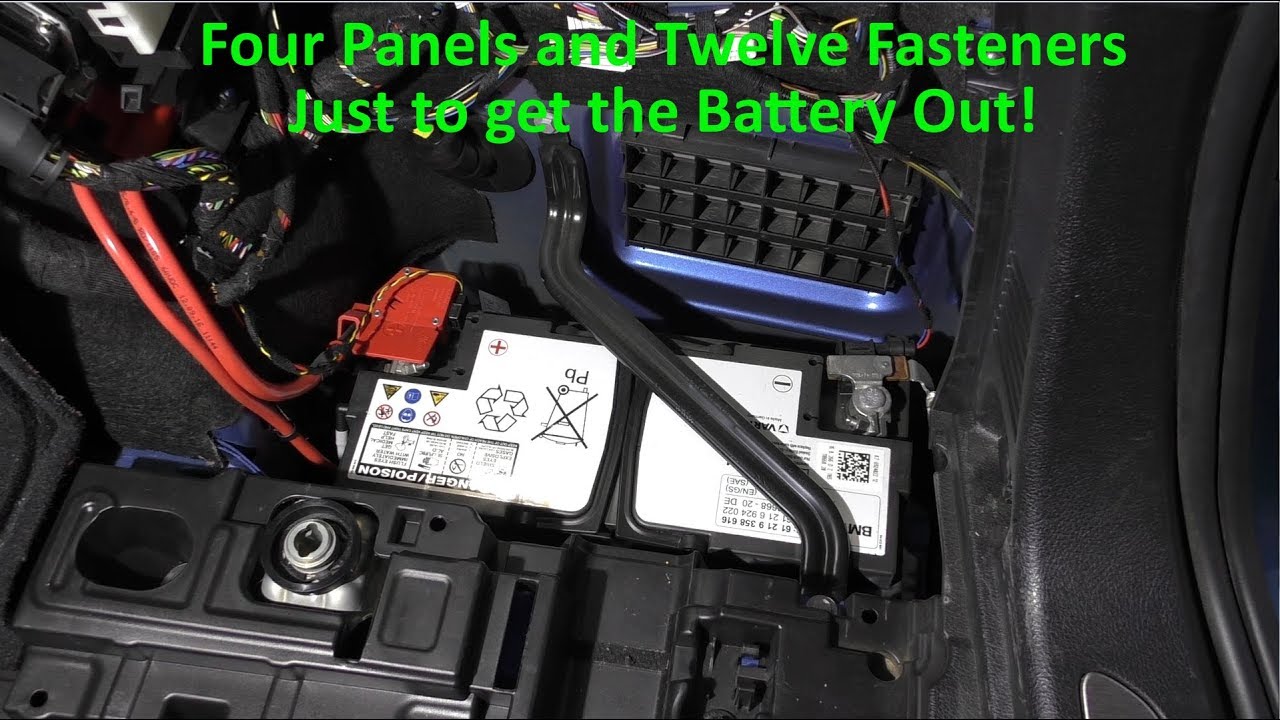
Remove Trunk Trim Safely
BMW hides batteries under trunk carpet—forcing panels breaks clips. Start by opening the trunk and lifting the carpet using the integrated pull tab. Remove the curved plastic/metal cover secured by two 10mm nuts (or screws on older models). Fold the carpet backward; never yank it. If you hear cracking, you’re pulling too hard—recheck for hidden fasteners along the edges.
Identify Critical Components Before Removal
Spot three key elements before disconnecting anything: The rubber vent hose (small tube clipped to the battery side), the metal hold-down bracket across the top, and the black Intelligent Battery Sensor (IBS) box on the negative cable. Note the vent hose routing—it must reconnect to the chassis port. The IBS triggers registration requirements; skipping this causes charging errors.
Remove Old BMW Battery in 6 Critical Steps
Execute Safe Disconnection Sequence
Never skip the sleep period! Lock the car and wait 15–30 minutes for modules to power down. Attempting removal while systems are awake risks voltage spikes that fry electronics.
- Disconnect negative terminal first: Use 10mm socket to loosen nut. Lift cable straight off, then secure it with a zip-tie against the chassis.
- Remove positive terminal: Flip up the red protective cover, then disconnect with 10mm socket.
- Release power-distribution box: Press side clips with flathead screwdriver and lift clear.
- Pull off vent hose: Yank straight off the battery nipple—don’t twist.
- Remove hold-down bracket: Locate bolts (typically one 13mm bottom bolt requiring extension).
- Lift battery out: Grip firmly—it weighs 45–60 lbs. Clear trim edges to avoid dropping it.
Warning: If the negative cable sparks when disconnected, the car wasn’t fully asleep. Wait longer next time.
Install New BMW Battery to Prevent Charging Errors
Position and Secure Without Damage
Slide the new battery under the front lip, ensuring the terminals face the correct direction (positive toward front on most models). Verify snug fit—aftermarket batteries sometimes sit higher. Reuse the hold-down bracket but don’t overtighten; 5 Nm torque is sufficient. Cranking the bolts too hard cracks the case.
Reconnect Components in Exact Order
- Attach vent hose: Use the included adapter if diameters differ. Route toward the chassis vent port—never kink it.
- Reinstall power-distribution box: Press until you hear a solid click.
- Connect positive terminal: Hand-tighten to 5 Nm. Close the red cover immediately.
- Connect negative terminal: Expect a small spark—it’s normal. Tighten to 5 Nm.
- Reassemble trim: Replace the curved brace and trunk carpet in reverse order.
Pro Tip: Coat terminals with anti-corrosion gel before reconnection. It prevents voltage drop from oxidation—a hidden cause of “weak battery” symptoms.
Register New Battery to Stop Warning Lights

Why Skipping Registration Causes Failure
BMW’s Intelligent Battery Sensor (IBS) adjusts charging based on battery age and type. Install a new AGM battery without registration, and the alternator undercharges it—tripping “Increased battery discharge” warnings within days. The IBS box on your negative cable makes this step mandatory on all post-2002 BMWs.
DIY Registration with Affordable Tools
Use a Foxwell NT510 ($100) or Carly app ($15) instead of paying the dealer $120. Steps:
1. Plug tool into OBD-II port (under dash)
2. Turn ignition ON (engine OFF)
3. Navigate: Body > Power Supply > Battery > Register Battery Replacement
4. Enter original Ah rating (e.g., 90Ah) and AGM technology
5. Input battery serial number from the label
6. Confirm—no coding needed if specs match
Critical: Never register a lead-acid battery as AGM—it causes dangerous overcharging.
Reset Systems After Battery Replacement
Your BMW resets multiple functions when power is cut. After starting the engine:
– Reinitialize windows: Hold switch up for 5 seconds after glass closes
– Reset steering sensor: Drive straight for 5–10 minutes on a flat road
– Restore presets: Reset clock, radio stations, and sunroof limits
– Recalibrate alternator: Drive 10+ minutes to let the IBS adapt
Skip these steps, and you’ll face erratic window operation or steering warnings.
Avoid These 4 Costly DIY Mistakes
Skipping Sleep Mode Causes Electrical Damage
Rushing the 15–30 minute sleep wait lets control modules stay active. When you disconnect terminals, voltage spikes can fry the DME or iDrive—resulting in $1,000+ repairs. Always verify sleep by checking for extinguished hazard lights.
Wrong Terminal Disconnection Sequence
Removing positive before negative risks shorting tools across the chassis. Always disconnect negative first and reconnect it last. A single slip here can melt wiring harnesses.
Overlooking Battery Specifications
Installing a 70Ah battery in an 80Ah-required model starves power-hungry systems like the HVAC compressor. Match both Ah rating (e.g., 90Ah) and group size (H7) exactly. Aftermarket CCA (850 vs OEM 640) is acceptable—but physical dimensions must fit.
Forgetting Core Recycling
Return your old battery to any auto store for a $12 core refund. Leaving it in the trunk adds weight and risks acid leaks during sharp turns.
Your BMW should now start instantly with no warning lights. Drive for 10 minutes to finalize system calibration, then enjoy the $200+ you saved. For long-term reliability, clean terminals every 6 months and use a BMW OEM trickle charger if the car sits unused for over 5 days. Remember: Proper registration isn’t optional—it’s what keeps your new battery from failing prematurely. If parasitic drain was the real culprit, tackle that next with a multimeter test before your replacement dies.


