
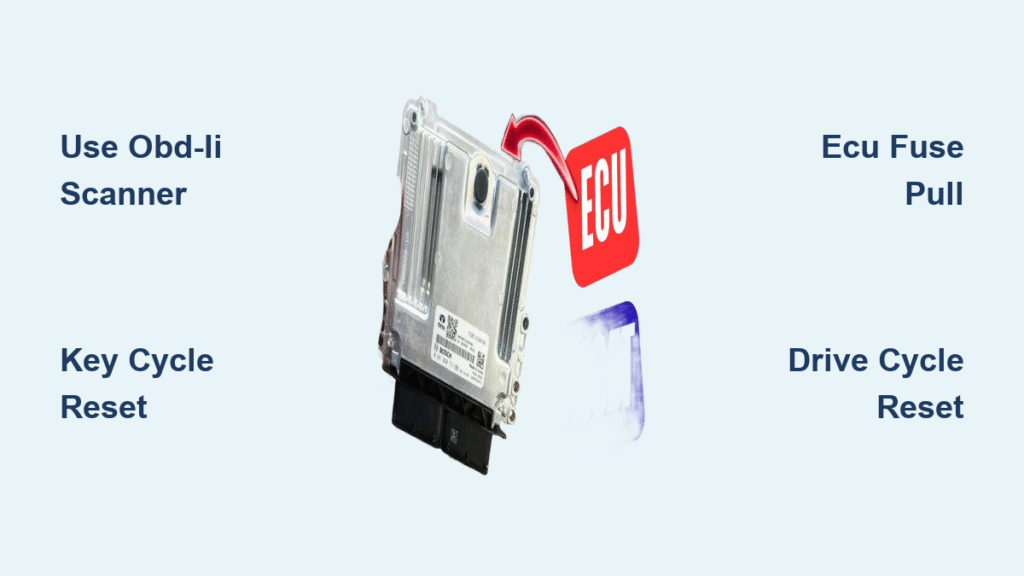
That persistent check engine light won’t turn off even after you’ve fixed the underlying issue, or your engine feels sluggish following recent repairs. Disconnecting the battery might seem like the obvious fix, but it erases radio presets, clock settings, and could trigger anti-theft systems—forcing you into a reprogramming nightmare. Modern vehicles offer smarter solutions. You can reset your car’s computer without touching the battery terminals, preserving all your settings while resolving performance issues. This guide reveals five proven methods to reset your car computer without disconnecting battery—saving you hours of frustration and preventing costly dealership visits.
How to Reset Car Computer with OBD-II Scanner

Grab Your Scanner and Locate the Port
Your OBD-II port sits under the dashboard near the steering column—a trapezoid-shaped socket standard on all vehicles from 1996 onward. Grab a scanner ($20 for basic models, up to $500 for professional units). Bluetooth versions pair with smartphone apps, while standalone tools offer deeper diagnostics. Pro tip: If your scanner won’t power on, check if your ignition must be in “ON” position first—some models require this.
Execute the Reset in 8 Critical Steps
- Turn ignition OFF completely—no accessories running
- Insert scanner firmly until you hear a click
- Power ON ignition (position II) but don’t start the engine
- Wait 15 seconds for automatic VIN detection
- Navigate to “Clear Codes”—avoid “Read Codes” by mistake
- Confirm reset when prompted (this deletes stored data permanently)
- Turn ignition OFF, remove scanner, then restart the engine
- Idle for 5 minutes—watch for roughness as ECU rebuilds fuel maps
Why Your Engine Might Stumble After Reset
Expect sputtering or high idle for 2-3 minutes post-reset. This happens because your ECU erased long-term fuel trims (±30% adaptations) and must recalibrate from scratch. Critical sign of success: Your scanner shows “No Codes Found” within 60 seconds. If the check engine light returns immediately, an unresolved mechanical issue exists—don’t reset again.
Manual Ignition Reset That Actually Works
The 3-Second Key Cycle Fix for Temporary Glitches
This method clears sensor hiccups without tools. Precision timing is non-negotiable:
– Turn key to ON position for exactly 3 seconds (dash lights fully illuminate)
– Turn completely OFF for 3 seconds (remove key if needed)
– Repeat twice more (three cycles total)
– Start the engine on the fourth attempt
Works best for: Recent battery replacements, temporary voltage spikes, or after clearing simple codes like P0171 (lean mixture). Won’t fix persistent issues like P0300 (random misfires).
Extended 10-Minute Reset for Stubborn Codes
For codes that reappear after basic resets:
– Turn key ON (engine off) and wait 10 minutes—listen for the fuel pump cycling (a 2-second whirr every 30 seconds)
– Turn OFF completely
– Start engine and idle 5 minutes with A/C and lights off
Warning: This drains 5-10% of battery charge. Verify your battery is above 75% charge first—otherwise, you’ll strand yourself mid-reset.
ECU Fuse Pull Reset (No Battery Disconnection Needed)
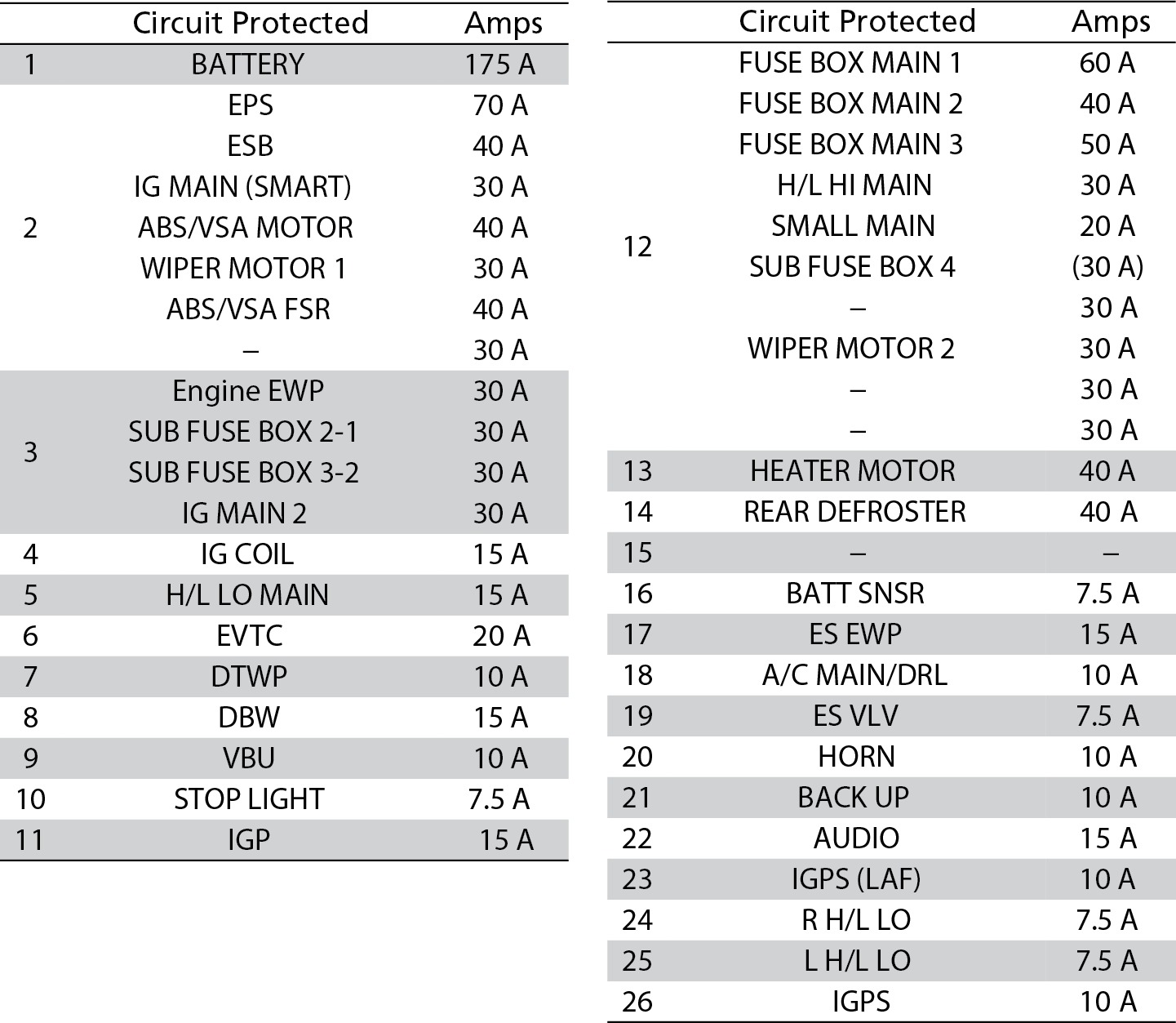
Identify the Exact ECU Fuse
Your fuse box likely has a diagram on its lid. Look for labels like “ECU,” “ECM,” or “PCM”—typically a 10-15 amp fuse in the under-hood box. Never guess: Pulling the wrong fuse (e.g., “ABS” instead of “ECM”) disables critical safety systems. Consult your owner’s manual if uncertain.
Avoid Costly Mistakes During Fuse Removal
- Turn ignition OFF and remove keys
- Use plastic fuse pullers—metal pliers risk short-circuiting
- Wait 15 minutes exactly—this discharges ECU capacitors fully
- Reinsert fuse with firm pressure until it clicks into place
- Start engine immediately and idle 10 minutes without touching the gas pedal
Red flag: If your radio asks for a security code after this, you pulled the wrong fuse. Stop and verify diagrams before proceeding.
Drive Cycle Reset for Complete ECU Relearning
Follow This Exact 50-Mile Driving Pattern
Forget “drive normally”—your ECU needs specific conditions to reset:
– Cold start phase: Idle 5 minutes from cold, then drive gently until engine hits 195°F
– Highway phase: Maintain 55-65 mph for 15 minutes (use cruise control)
– City phase: Perform 10 full stop-and-go cycles with smooth acceleration
– Cool-down phase: Park and idle 5 minutes with headlights/A/C off
Why this works: The ECU rebuilds fuel trims and transmission shift points using real-world data. Complete this over 3 days—rushing causes incomplete adaptation.
When Resetting Fails: Critical Troubleshooting
Immediate Warning Signs Needing Professional Help
Don’t ignore these post-reset symptoms—they indicate serious issues:
– Check engine light returns within 1 mile (mechanical problem unresolved)
– Engine stalls below 800 RPM (vacuum leak or faulty sensor)
– Exhaust smoke or grinding noises (internal damage)
– Multiple warning lights (ABS, airbag, traction control)
Action step: Scan for codes immediately. If you see P0300 (misfires) or P0171/P0174 (lean codes), investigate vacuum hoses and oxygen sensors before attempting another reset.
Normal Relearning Symptoms (Don’t Panic)
Expect these for 50-200 miles after any reset:
– Rough idle for first 10 minutes of cold starts
– Hesitation when accelerating hard
– 10-15% lower fuel economy initially
– Emissions monitors showing “not ready”
Verification test: After 50 miles, scan for codes and check fuel trims. Long-term trims should settle between -5% to +5% (±30% indicates a problem).
Tool Recommendations for Flawless Resets

Budget Setup Under $30
- $22 Bluetooth OBD-II adapter (works with free Torque Pro app)
- $5 fuse puller kit (prevents bent fuses)
- Owner’s manual PDF (search “[your model] fuse diagram” online)
Why skip expensive scanners? Basic tools clear codes and verify resets—no need for $300 devices unless you own European cars requiring manufacturer-specific protocols.
Final Verification: Did Your Car Computer Reset Successfully?
Your reset succeeded if:
✅ No stored codes appear after a full drive cycle
✅ Idle stabilizes within 5 minutes of cold starts
✅ Fuel economy returns to pre-issue levels within 100 miles
✅ All emissions monitors show “ready” before state inspection
Critical reminder: Resetting erases learned adaptations—it does not fix mechanical problems. If performance issues persist after 200 miles of driving, investigate sensor failures or vacuum leaks instead of repeating resets. Always complete 50-100 miles of varied driving to let the ECU fully relearn optimal settings. For European vehicles (BMW, Mercedes, Audi), factory scanners are often mandatory—don’t risk security lockouts with generic tools.


