
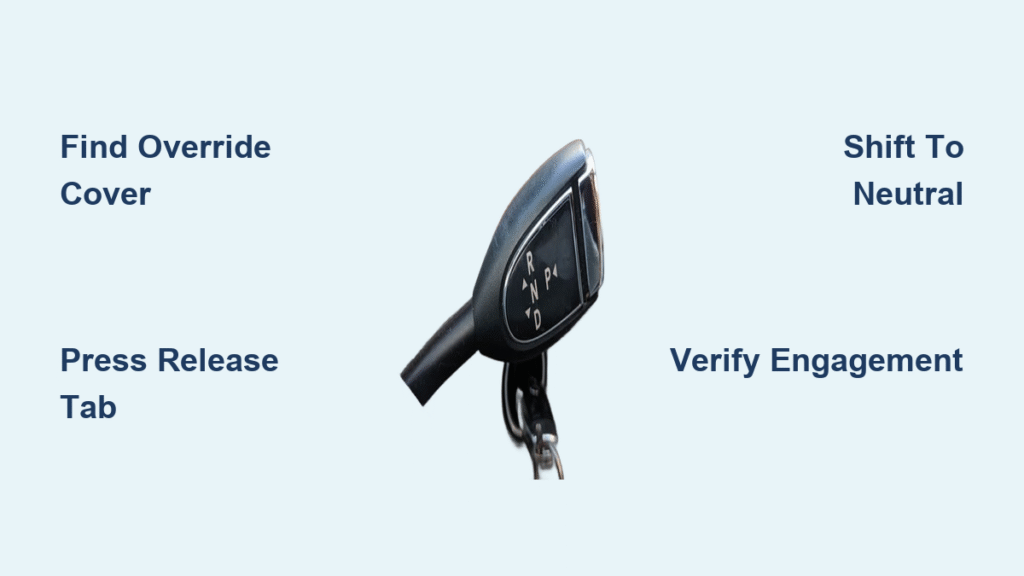
You’re stranded in a parking spot with a dead battery, and the worst part? Your car won’t shift out of park no matter how hard you press the brake. This happens to thousands of drivers monthly when the brake-shift interlock system fails without electrical power. That frustrating “locked in park” scenario traps you because modern automatic transmissions require a live circuit to release the gear selector—a safety feature that backfires when your battery dies. The good news is every automatic vehicle has a mechanical override, and this guide shows you exactly how to activate it safely in under five minutes.
Don’t risk damaging your transmission by forcing the shifter or calling an expensive tow unnecessarily. Whether you need to roll your car out of a garage, position it for a jump start, or prepare for towing, this step-by-step manual override process works on virtually all automatic vehicles. You’ll discover precisely where to find your hidden release mechanism, the right tools to use (no special equipment needed), and critical safety steps that prevent accidents during this emergency procedure.
Why Your Transmission Locks in Park with a Dead Battery
The brake-shift interlock system physically blocks your shifter from moving out of park without brake pedal input—a federal safety requirement on all U.S. vehicles since 2010. When your battery dies, this electrical circuit can’t complete its safety check, leaving the transmission mechanically locked even when you press the brake. Understanding this mechanism explains why your car won’t budge despite normal shifter operation.
How the Shift-Lock Solenoid Fails Without Power
Inside your center console, a small solenoid physically blocks the shifter path. With ignition power, pressing the brake sends a signal to retract this lock. But with zero battery voltage, the solenoid stays engaged, creating an immovable barrier. The manual override exists specifically to bypass this electrical dependency through direct mechanical access.
Pre-2010 Vehicles Without Mandatory Interlocks
While vehicles manufactured before 2010 might lack this system entirely, don’t assume yours is exempt. Many automakers implemented brake-shift interlocks voluntarily before the federal mandate. If your older car won’t shift with a dead battery, it likely has a manual release—never force the shifter as this risks transmission damage.
Essential Safety Steps Before Moving a Dead-Battery Car
Skipping these precautions could cause your vehicle to roll uncontrollably. Always complete these steps before touching the manual release mechanism, regardless of how urgently you need to move your car.
Engage the parking brake with firm resistance – Pull the handle until you hear 3-5 distinct clicks or press the pedal until it won’t move further. Test by attempting to rock the car side-to-side; if it moves more than an inch, reapply the brake. This becomes your primary safety anchor once neutral is engaged.
Turn the ignition key fully to “on” position – Even with a dead battery, this mechanical action aligns internal components and may reduce resistance during the override process. Insert your key and rotate clockwise until it stops—do not force it if stuck.
Clear your movement path completely – Check for slopes, curbs, obstacles, or traffic in both directions. If on any incline, place wheel chocks against the rear tires (or use heavy rocks/wood blocks) before proceeding. Never attempt this procedure with children or pets nearby.
Finding Your Vehicle’s Manual Shift Release in 30 Seconds

The manual park release hides in plain sight but blends perfectly with your interior. Start your search in these high-probability locations before consulting your owner’s manual.
Center console near the shifter base – Run your fingers around the gear selector housing for a 1-2 inch square or rectangular plastic cover matching your console color. It typically has slightly different texture (softer plastic) and may feature a tiny slot for tool insertion. On Honda and Toyota models, it’s often directly adjacent to the “P” position.
Hidden compartments and alternative spots – Check under the cup holder lid, inside the armrest storage bin, or along the passenger footwell side panel. Ford and GM vehicles sometimes place it beneath a rubber mat near the shifter. If invisible, press the shifter’s brake-release button while inspecting for hidden openings—some releases only appear when the button is depressed.
Removing the Shift Lock Cover Without Breaking Your Console
Forcing this cover causes expensive interior damage. Use the right technique to remove it safely on your first attempt.
Select the proper prying tool – A flathead screwdriver (3-5mm tip) works best, but your car key or sturdy butter knife substitutes in emergencies. Avoid sharp objects like pocket knives that can scratch or slip.
Apply controlled 45-degree pressure – Insert your tool into the seam or slot and gently twist upward while wiggling side-to-side. Apply steady pressure for 2-3 seconds—most covers pop free with less force than opening a soda can. If resistance exceeds this, stop and try a different insertion point to avoid cracking the plastic.
Activating the Manual Override: Correct Pressure and Direction
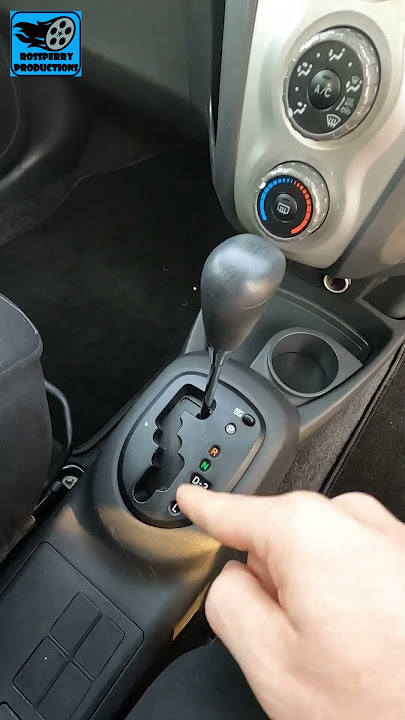
The release mechanism varies significantly by manufacturer. Identifying your type prevents broken tabs and wasted effort during this critical step.
Push-Down Release Tabs (Common in Honda, Nissan, Toyota)
With cover removed, locate a small white or black plastic tab (about pencil-eraser size). Insert your tool and press straight down with firm but controlled pressure—about 5 pounds of force. You should feel a distinct “click” as the lock disengages. Never pry sideways as this snaps the tab.
Slide-Mechanism Releases (Ford, GM, Chrysler)
Look for a small metal lever or plastic slider. Move it toward the driver’s side door while applying light pressure (about 3 pounds). If arrows are visible, follow their direction—most require 1/4 inch of travel. Stop immediately if you feel metal-on-metal grinding.
Shifting to Neutral While Holding the Release Mechanism
Timing and coordination prevent the transmission from relocking mid-shift. This step fails most often due to premature release.
Maintain constant override pressure – Keep your tool firmly engaged on the release mechanism throughout the entire shifting process. Releasing even slightly will trigger the lock to re-engage, requiring you to restart the procedure.
Shift smoothly through neutral – Grasp the shifter as normal and move it toward “N” while simultaneously pressing the brake pedal. You should feel normal resistance without grinding. If the shifter catches, verify you’re holding the override correctly before applying more force.
Testing Neutral Engagement Before Pushing Your Car
Never assume neutral is engaged—verify before releasing the parking brake. This simple test prevents dangerous rolling accidents.
Rock test with parking brake engaged – Apply firm hand pressure to the rear bumper while observing wheel movement. If the car rolls more than 2 inches, the transmission isn’t fully in neutral. Repeat the override process, ensuring you maintain pressure until the shifter passes the “N” detent.
Confirm shifter stability – Gently release pressure on the manual override while keeping the shifter in neutral. The gear selector should remain in place without springing back toward park. If it moves, hold the override longer during your next attempt.
Steering and Stopping Without Power When Pushing Your Car
Dead batteries disable power steering and brakes after one application. These techniques make manual movement safer.
Steering requires two people minimum – One person must sit in the driver’s seat to steer and operate the mechanical brakes. Without power steering, turning the wheel at low speeds requires 3-4 times normal effort—never attempt sharp turns when pushing alone.
Brake pedal technique – Pump the pedal gently 3-5 times to build residual pressure before each stop. Expect 2-3 times longer stopping distance than normal. Always have a spotter 10 feet in front of the vehicle watching for obstacles.
Returning to Park After Moving Your Vehicle
Shifting back to park requires repeating the override process—never assume the transmission resets automatically.
Secure parking brake first – Before releasing the manual override, reapply the parking brake with firm resistance. If you shift to park while the car is moving even slightly, you’ll damage the transmission parking pawl.
Complete the shift sequence – Reactivate the manual release mechanism, shift to “P”, then verify the shifter locks securely. Only release the parking brake once you confirm the transmission is fully engaged in park.
5 Signs You Need a Tow Truck Instead of DIY
Forcing the procedure when these conditions exist risks costly transmission repairs. Call professionals immediately if:
The manual release cover is missing or broken – Debris in the mechanism can jam the solenoid. Attempting override may shear internal components requiring $1,500+ repairs.
You hear grinding during shifting – This indicates the parking pawl hasn’t fully disengaged. Continuing could lock the transmission permanently.
The vehicle won’t roll on level ground – Even with neutral engaged and parking brake released, resistance suggests a deeper transmission issue requiring diagnostics.
You’re on a steep incline – Gravity increases rolling risk exponentially. Professional tow trucks use wheel straps and specialized dollies for safe movement.
Multiple helpers aren’t available – Safe manual movement requires 3 people minimum: one to steer/brake, two to push, and a spotter. Never attempt alone.
Final Verification Checklist
✓ Parking brake firmly engaged before starting
✓ Manual release cover properly reinstalled
✓ Vehicle rolls freely in neutral on level surface
✓ Transmission shifts smoothly back to park
✓ All tools and covers accounted for
Remember: This procedure works identically across 95% of automatic transmissions, but exact release locations vary by manufacturer. Consult your owner’s manual for vehicle-specific diagrams—most keep it in the glove compartment for emergencies. If you frequently experience dead batteries, replace your aging battery before it strands you; most last 3-5 years. For immediate help, roadside assistance services like AAA can activate the override in under 10 minutes for less than a tow fee. Always prioritize safety over speed—taking 60 extra seconds to verify neutral engagement prevents thousands in repair costs.


