That frustrating moment when your engine barely turns over on a cold morning—that’s your car battery struggling to deliver enough amps. While everyone knows batteries are “12 volts,” how many amps is car battery capability actually delivers determines whether you’re driving to work or calling for a tow. Most drivers confuse amperage ratings, leading to costly replacements or unexpected breakdowns. Understanding your battery’s true power capacity—especially Cold Cranking Amps (CCA), Cranking Amps (CA), and Amp-Hours (Ah)—is critical for reliable starts and electrical system performance. In this guide, you’ll learn exactly what those numbers mean, how temperature and age impact real-world output, and how to choose the right battery for your vehicle.
Why Cold Cranking Amps Determine Winter Starts
Your battery’s Cold Cranking Amps (CCA) rating is the make-or-break number for cold-weather reliability. This specification measures the amps a 12-volt battery can deliver at 0°F for 30 seconds while maintaining at least 7.2 volts. Most standard passenger vehicles require 300-600 CCA to overcome engine oil thickening in freezing temperatures. If you drive a high-performance sedan or sports car, you’ll need 600-800 CCA to handle tighter engine tolerances. Diesel truck owners face the toughest challenge—800-1000+ CCA is essential to combat higher compression ratios that demand massive starting power.
How CCA Differs From Cranking Amps (CA)
Don’t confuse CCA with the higher Cranking Amps (CA) rating stamped on your battery. CA measures current output at 32°F rather than 0°F, resulting in 20-25% higher numbers than CCA. For example, a battery rated at 500 CCA typically shows 625 CA. While CA gives you useful moderate-weather performance data, CCA is the critical number for winter reliability—never base your purchase decision solely on the higher CA figure. Always match or exceed your vehicle manufacturer’s CCA specification, especially if you live in northern climates where temperatures regularly dip below freezing.
Reserve Capacity: Your Electrical Lifeline During Failure
When your alternator quits mid-drive, Reserve Capacity (RC) becomes your battery’s emergency power supply. This rating indicates how many minutes your battery can deliver 25 amps at 80°F before voltage drops below 10.5 volts. Standard car batteries provide 45-90 minutes of reserve power—enough to keep lights and essential electronics running until you reach safety. Premium AGM (Absorbent Glass Mat) batteries extend this to 90-150 minutes, crucial for modern vehicles packed with power-hungry infotainment and safety systems. Check this number when replacing batteries if you frequently drive in remote areas.
Amp-Hours: Your Battery’s True Capacity Measure
While CCA gets your engine running, Amp-Hours (Ah) reveal how long your battery can sustain electrical loads. Think of Ah as your battery’s “fuel tank” size—it measures total charge capacity rather than instantaneous power. A 60Ah battery can theoretically deliver 3 amps for 20 hours before depletion. Actual vehicle requirements vary significantly by size:
- Compact cars: 35-45 Ah (adequate for basic electrical systems)
- Midsize sedans: 45-65 Ah (supports added features like power seats)
- Full-size SUVs: 65-80 Ah (handles premium audio and multiple displays)
- Heavy-duty trucks: 75-100 Ah (powers winches, lighting bars, and accessories)
Pro Tip: If you’ve added aftermarket electronics like refrigerators or campervan setups, prioritize higher Ah capacity over CCA. A larger “fuel tank” prevents deep discharges that kill batteries prematurely.
Real-World Amp Draw During Critical Operations
Starting Power: Why Your Starter Demands Massive Current
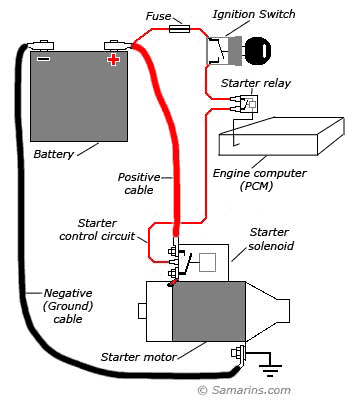
When you turn the key, your starter motor becomes the hungriest component in your vehicle. During normal cranking, it pulls 100-200 amps for 1-3 seconds. But on a 20°F morning, that demand spikes to 250-400 amps as thickened oil increases engine resistance. Diesel owners face even greater challenges—400-800 amps are required to overcome compression ratios 2-3 times higher than gasoline engines. This explains why weak batteries often fail precisely when you need maximum power: cold starts demand peak amperage exactly when chemical reactions in the battery slow down.
Charging System Output: How Your Alternator Replenishes Power
After starting, your alternator works to replace consumed energy while powering all electrical systems. Modern alternators output 40-120 amps depending on vehicle specifications, but only 2-10 amps actually flow into the battery during normal driving. Crucially, charging current should never exceed 10% of your battery’s Ah rating—so a 60Ah battery needs no more than 6 amps for safe, long-term charging. Exceeding this threshold causes excessive heat and gassing that warps internal plates. This is why cheap “10-amp” chargers often damage batteries—they deliver full current even when the battery is nearly full.
Temperature’s Devastating Impact on Amp Delivery
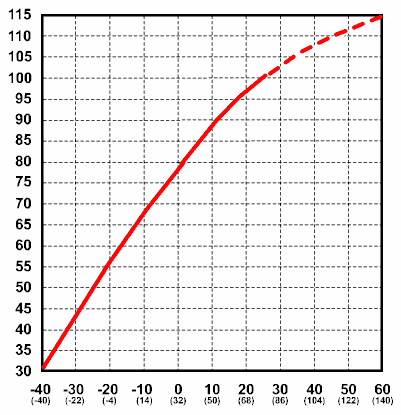
Your battery’s rated amps become fiction once temperatures drop. At a comfortable 80°F, your battery delivers 100% of its CCA rating. But at 32°F, capacity plummets to 65%—meaning a 600 CCA battery performs like a 390 CCA unit. By 0°F, you’re down to 40% capacity, turning that same battery into a mere 240 CCA performer. This isn’t just about cold weather; age multiplies temperature effects:
- New battery: Delivers 100% rated CCA at 0°F
- 3-year-old battery: May provide only 70-80% of rated CCA
- 5-year-old battery: Often drops to 50-60% capacity
Critical Insight: A battery that barely starts your car at 30°F might be completely dead at 0°F. If you notice slow cranking as temperatures dip, test your battery immediately—it’s giving you its last warning.
How to Measure Your Battery’s True Amp Performance
DIY Multimeter Testing for Current Draw
Grab a digital multimeter to check real-world amperage. Set it to the 10A DC scale, then disconnect your battery’s negative terminal. Place the multimeter probes between the terminal and cable to create a series connection. With everything off, you should see less than 50mA (0.05A)—any higher indicates a parasitic drain. During cranking, expect 100-400+ amps depending on engine size and temperature. Warning: Never measure cranking amps without proper high-amp probes—this can destroy standard multimeters.
Professional Load Testing: The Definitive Check
Auto parts stores offer free load testing that simulates real starting demands. Technicians use carbon pile testers to apply 50% of your battery’s CCA rating for 15 seconds while monitoring voltage. A healthy battery maintains above 9.6 volts throughout the test while delivering the required current. If voltage drops below this threshold, your battery can’t sustain necessary amperage—even if it shows 12.6 volts at rest. This test is critical before winter; many “good” batteries fail under actual load.
Choosing Replacement Batteries: Matching Amp Requirements

Never assume “bigger is better” when selecting a new battery. Focus on three non-negotiable specs:
- CCA rating equal or higher than OEM specification (prioritize this for cold climates)
- Exact physical dimensions that fit your battery tray and hold-down
- Amp-hour capacity appropriate for your electrical load (higher for vehicles with many accessories)
Hot Climate Hack: In southern states, prioritize higher Ah capacity over max CCA—your battery battles constant air conditioning loads rather than cold starts. A 70Ah battery with 550 CCA often outperforms an 800 CCA/50Ah unit in Phoenix summers.
Safe Charging Practices: Amp Rates That Won’t Damage Your Battery
Charging amps require strict adherence to prevent dangerous failures. Follow these guidelines based on your situation:
- Trickle charging (storage): 1-2 amps for months-long maintenance
- Standard recovery charging: 4-10 amps overnight (8-12 hours)
- Emergency fast charging: 20-50 amps for 30-60 minutes (monitor constantly)
Critical Safety Rule: Never exceed 50 amps during charging. This threshold risks plate warping, thermal runaway, and explosive hydrogen gas buildup. Always disconnect the negative terminal first and wear eye protection—batteries can vent acid during charging. For daily maintenance, a smart charger that automatically switches to 1-2 amp float mode is ideal.
When Amp Measurements Signal Impending Failure
Your battery’s amperage behavior provides early warning signs of failure:
- Slow cranking with normal voltage: Starter draws required amps but battery can’t sustain voltage
- Rapid clicking sound: Voltage collapses below 9.6V during start attempt
- Dimming lights with accessories on: Battery can’t deliver required current under load
If professional testing shows your battery delivers less than 80% of its rated CCA, replace it immediately. A battery testing at 400 CCA when rated for 600 CCA has crossed the reliability threshold—it will fail when you need it most.
Understanding how many amps is car battery capability requires demystifying CCA, CA, and Ah ratings—but this knowledge prevents roadside emergencies. Remember that cold temperatures slash available amperage, while age compounds these losses. When replacing batteries, prioritize CCA for northern climates and Ah capacity for accessory-heavy vehicles in warm regions. Always verify real-world performance with load testing before winter, and never exceed 50-amp charging limits. By matching your battery’s amp specifications to actual driving demands, you’ll transform frustrating breakdowns into reliable starts for years to come. Keep this guide handy when shopping for your next battery—you’ll speak the language of amperage like a pro.