Your Honda Pilot won’t start, the dashboard lights flicker weakly, and you’re staring at a dead 12-volt battery. Before you waste $150 on a tow truck, know this: 90% of “dead battery” situations can be fixed in under 10 minutes with the right method. Honda’s engineering means you don’t need a mechanic—just the correct charging approach for your specific Pilot model. This guide cuts through the confusion with exact steps for jump-starting, solo charging, and full recharging tailored to Honda Pilot years 2003-2023. You’ll avoid dangerous mistakes like connecting cables wrong, prevent dashboard warning lights after charging, and learn why your battery died in the first place. Let’s get your SUV running again—safely and permanently.
Why Your Honda Pilot Battery Dies (And When It’s Not the Battery)
That clicking sound when you turn the key usually means a discharged 12-volt battery, but don’t assume replacement is needed. Honda Pilots commonly lose charge from parasitic drains like aftermarket dash cams drawing 25-50mA overnight. In freezing weather (below 32°F/0°C), chemical reactions slow so much that a battery at 75% health acts completely dead. If headlights glow dimly but the engine won’t crank, you likely have 10-15 minutes of surface charge left for a jump start. If everything is dead—no lights, no dash display—you need a dedicated charger, not jumper cables, to avoid stressing the alternator. Critical insight: 2016+ Pilots with Idle-Stop technology use AGM batteries that fail silently when discharged below 11.8V—never let voltage drop that low.
Where Honda Hides the Pilot Battery (2003-2023 Models)
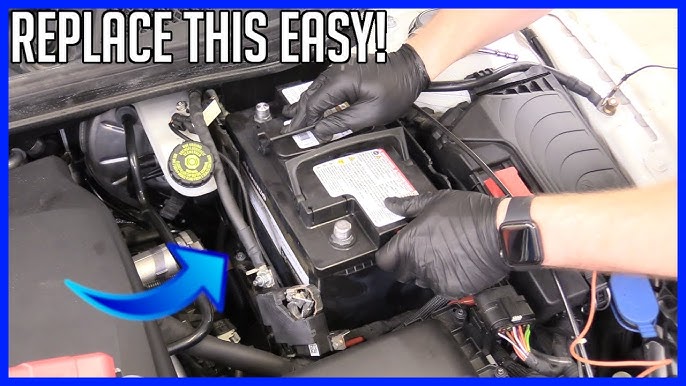
Don’t waste 10 minutes searching—Honda moves the battery location based on model year. For 2003-2015 Pilots, pop the hood and look left of the engine. It’s under a black plastic cover secured by two push pins (no tools needed). For 2016-2023 models with Idle-Stop, the AGM battery sits in the front passenger footwell—remove the lower dash panel to access it. Never skip this: Before touching anything, turn off all electrical loads. This includes USB chargers, dome lights left on by accident, and the “retained accessory power” that keeps the radio live for 10 minutes after exiting. Engage the parking brake firmly—your Pilot could roll if it lurches during cranking. And keep flames or sparks 3+ feet away; hydrogen gas from charging is explosive.
Three Charging Methods: Which Saves You Time Right Now

| Method | Time Required | Best For Your Situation | Critical Limitation |
|---|---|---|---|
| Jumper cables with second car | 5-10 minutes | Roadside emergency, slow cranking | Requires another vehicle; improper grounding risks fire |
| Portable jump starter | 3-5 minutes solo | No help available; completely dead battery | Must be pre-charged; max 3 attempts before damage |
| Smart battery charger | 4-12 hours | Deep discharge; battery storage; preventing future failure | Not for immediate starts; requires outlet access |
Choose fast: If the Pilot’s interior lights work but the engine cranks slowly, jump-start. If all electronics are dead, skip jumper cables—use a portable starter or charger. Never use a fast charger (>10A) on 2016+ AGM batteries; it permanently damages them.
Jumper Cables: Avoid the #1 Deadly Mistake
Connecting negative cables wrong causes battery explosions. Follow this sequence exactly:
- Red to dead battery: Clamp red (+) cable to Pilot’s positive terminal (shiny metal post, often marked “POS”).
- Red to donor battery: Connect other red clamp to working vehicle’s positive terminal.
- Black to donor battery: Attach black (-) clamp to working vehicle’s negative terminal.
- Black to Pilot ground: Clip final black clamp to unpainted metal on the engine block—never the dead battery’s negative post. This prevents sparks near hydrogen gas.
Start safely: Run the donor car at 1,500 RPM for 3 minutes. Attempt to start your Pilot. If it cranks slowly, check clamps for paint or corrosion. Pro tip: Remove metal watches—touching positive post and chassis with jewelry causes instant welding burns.
Portable Jump Starter: Solo Rescue Without Another Car
This is your lifeline when stranded alone. Do these 6 steps in order:
- Ensure Pilot ignition is OFF and jump starter is OFF.
- Connect red clamp → Pilot battery positive (+) terminal.
- Connect black clamp → negative (-) terminal (portable units allow direct connection).
- Power ON the jump starter (most have LED charge indicators).
- Crank engine in 5-second bursts—stop after 3 attempts if no start.
- Disconnect black first, then red after engine runs.
Critical warning: Never connect the jump starter while Pilot electronics are active. A sudden surge can fry the infotainment system. Keep the unit ≥6 inches from the battery—lithium packs overheat if placed directly on metal.
Smart Charger Settings: Preventing Costly AGM Damage

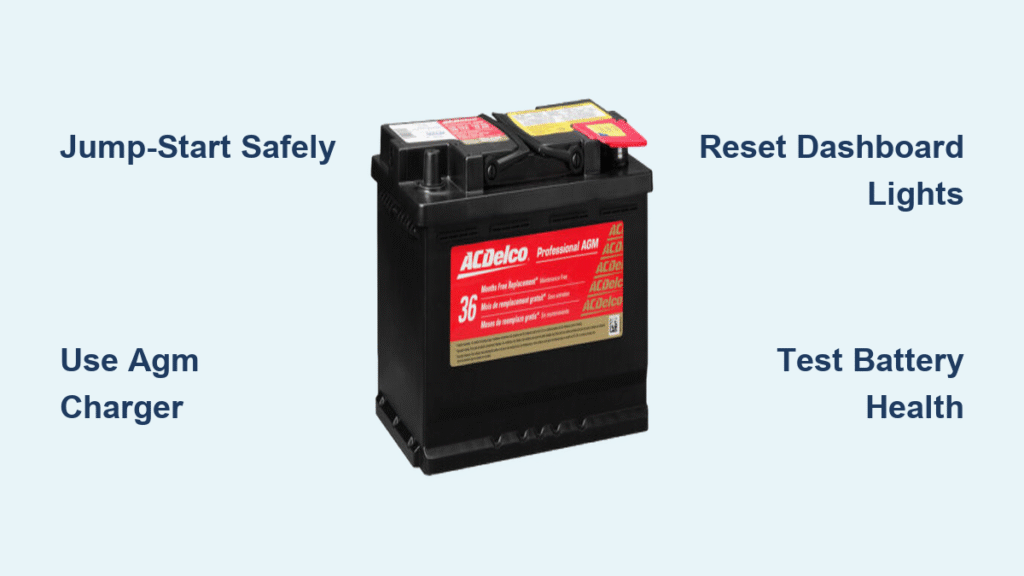
Using a standard charger on 2016+ Pilot AGM batteries risks catastrophic failure. Follow these exact steps:
- Set voltage first: Confirm charger dial reads 12V (not 6V/24V). For 2016+ AGM models, select “AGM” mode or max 14.4V.
- Check electrolyte: Only for pre-2016 flooded batteries—pop caps and top plates with distilled water if low.
- Connect in order: Red lead → positive post → Black lead → negative post (ground is optional).
- Select amperage:
• 2A (trickle): 12-24 hours for maintenance
• 5A (safe): 8-12 hours for moderate discharge
• 10A (emergency only): 4-6 hours—never use on AGM
Stop charging immediately if the battery feels hot (over 120°F/49°C). A smart charger’s amp meter dropping below 1A means it’s 95% charged. Leave it connected in “float” mode for storage.
Reset VSA and ACC Lights After Charging (Critical Step!)
Disconnecting the battery triggers terrifying dashboard warnings: flashing VSA®, ACC, and brake system lights. Do not panic—this is normal. Honda’s systems need recalibration:
- Start the engine and let it idle 30 seconds.
- Drive continuously at ≥12 mph (20 km/h) for 5-10 minutes—no stops.
- Maintain steady speed; avoid braking or accelerating hard.
All lights should extinguish within 2 miles. If amber warnings persist after 10 miles, schedule dealer diagnostics—this indicates unrelated faults like wheel speed sensor errors.
Test If Your Pilot Battery Holds a Charge
A jump start isn’t a fix—it’s a symptom check. Verify health in 3 steps:
- Voltage test: After 1 hour of sitting, measure with engine off. Healthy = 12.6V+ (12.4V = 75% charged; replace if <12.2V).
- Load test: Have AutoZone test for free—they apply 300A load. Voltage must stay >9.6V for 15 seconds.
- Alternator check: With engine running, voltage should read 13.8-14.8V. Below 13.5V means failing alternator.
Red flags for replacement: Slow cranking (under 200 RPM), needing weekly jump-starts, or age over 4 years in hot climates (Arizona/Texas) or 5 years elsewhere.
Prevent Your Pilot Battery From Dying Again
Monthly 5-minute maintenance routine:
– Clean terminals with baking soda/water mix and wire brush (remove negative cable first!)
– Apply dielectric grease to prevent corrosion
– Check hold-down clamp—loose batteries crack internally from vibration
For long storage (30+ days):
– Use a smart maintainer ($25 on Amazon) connected to battery posts, or
– Disconnect negative cable after ensuring battery is 100% charged
Critical for 2016+ AGM models: Never use standard chargers—only “AGM-compatible” units. Keep spares like dash cams unplugged.
Bottom line: Charging your Honda Pilot battery isn’t guesswork—it’s following Honda’s exact specifications. A portable jump starter ($60) in your cargo area eliminates roadside panic, while a smart charger prevents future failures. Remember: 2016+ Pilots demand AGM-specific care, and those dashboard lights will reset with the correct drive cycle. If your battery fails two consecutive load tests, replace it immediately—OEM specs require Group 24F/35 size with 550-600 CCA. Keep this guide in your glovebox; next time your Pilot won’t start, you’ll be driving away in 7 minutes flat.


