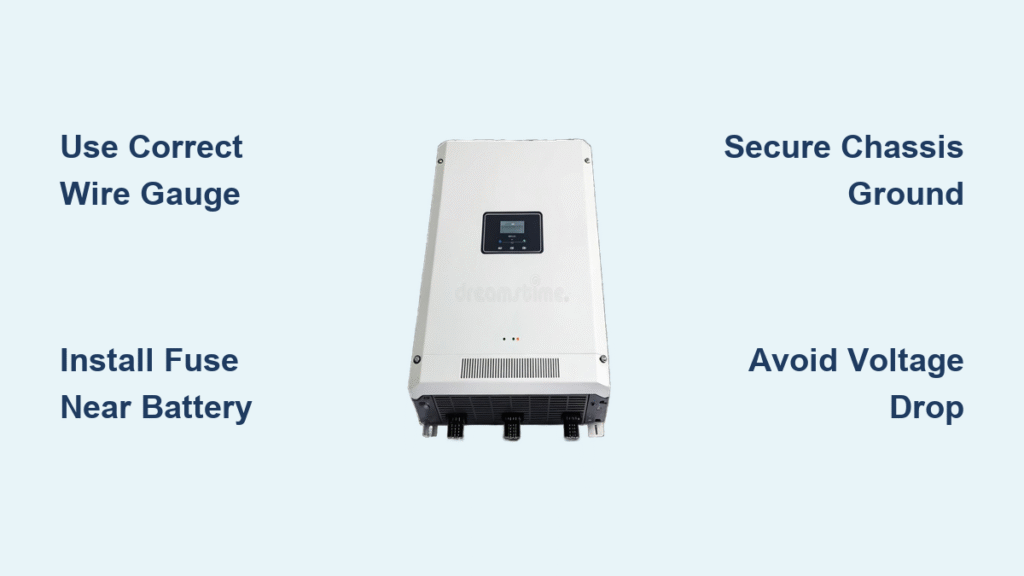
Your laptop dies mid-presentation during a road trip, the kids’ tablets hit 1% battery at a rest stop, and you need to power a CPAP machine for the night. A car battery inverter solves these emergencies—but improper installation risks melted wires, drained batteries, or even underhood fires. This guide reveals exactly how to connect inverter to car battery for reliable 120V power without compromising safety. You’ll learn professional wiring techniques that prevent voltage drops, calculate precise fuse sizes, and avoid the top 3 mistakes that destroy inverters within minutes.
Selecting Correct Wiring Components for Your Inverter

Skip aluminum-clad wires—they overheat and fail under sustained loads. Your inverter connection lives or dies by these four components: pure copper stranded wire (OFC, not CCA), ANL/MAXI fuse holder, marine-grade ring terminals, and a 12V multimeter. For a 400W inverter, you’ll need 8 AWG copper wire for runs under 3 feet; stretch beyond 6 feet and step up to 6 AWG. Always verify wire gauge against your actual inverter wattage using the voltage drop chart below—never assume based on generic advice.
Critical Fuse Selection Rules
- Fuse amps = Inverter watts ÷ 10 (round up to nearest standard size)
- Mount fuse holder within 12 inches of battery positive terminal—this is non-negotiable for fire prevention
- Use ignition-protected MAXI/ANL fuses in engine bays (standard blade fuses won’t contain arc flashes)
- Example: A 1000W inverter requires a 100A fuse. Install it 6 inches from the battery post using stainless steel hardware.
Why Ring Terminals Beat Alligator Clips
Factory-supplied clamp cables create dangerous resistance points. Crimp marine-grade ring terminals with adhesive-lined heat shrink—this seals out corrosion and prevents terminal loosening from engine vibration. Sand bare metal on chassis grounding points and use star washers to penetrate paint. A loose connection here causes voltage spikes that fry sensitive electronics like laptop chargers.
Quick-Connect Methods for Emergency Power
180W Accessory Socket Setup (Under-Dash Fuse Limits)
Plug-and-play inverters max out at 180W due to your vehicle’s 15A accessory circuit fuse. This method powers laptops or LED lights but fails instantly with surge loads—try running a mini-fridge and you’ll melt the socket. Check your fuse box for “CIG” or “AUX” labels; replace the stock fuse with a time-delay version only if wiring supports it (most don’t). Never exceed 150W continuous to avoid repeated fuse blows.
Emergency Clamp Connection (3-Minute Power Fix)
When stranded with a dead phone:
1. Park on level ground, engine OFF, emergency brake engaged
2. Clip red clamp directly to battery positive post (not terminal cover)
3. Attach black clamp to unpainted chassis metal 2+ feet from battery
4. Place inverter on non-conductive surface (never carpet!)
Critical warning: This bypasses all fusing—limit to 400W loads for 15 minutes max. Monitor wire temperature; if insulation softens, disconnect immediately. Always reverse removal order: unplug devices → inverter OFF → black clamp → red clamp.
Permanent Wiring: Step-by-Step Installation Protocol
Fuse Placement and Wire Routing Safety
Route positive wire through existing firewall grommets—never drill new holes near fuel lines. Secure cables every 12 inches using nylon ties on rigid frame points (avoid plastic clips that melt). Cross exhaust components at 90° angles with split-loom tubing protection. For inverters over 800W, add high-temp fiberglass sleeve where wires pass near manifolds. Remember: A single chafed wire against hot metal can ignite within seconds.
Grounding That Prevents Electrical Noise
Connecting negative directly to battery negative creates ground loops that disrupt radio and GPS. Instead:
1. Sand a 2-inch diameter spot on bare chassis metal near the inverter
2. Use star washer under ring terminal for metal-to-metal contact
3. Torque terminal to 8-10 ft-lbs (hand-tight plus 1/4 turn)
This technique reduces voltage fluctuations that cause “low battery” false alarms on sensitive electronics.
Connection Sequence to Prevent Deadly Sparks
Follow this exact sequence to avoid arc flashes:
1. Mount inverter with 3+ inches clearance for airflow (heat kills inverters faster than overloads)
2. Connect negative wire to chassis ground point (black terminal)
3. Route positive wire to fuse holder with fuse removed
4. Attach positive wire to inverter terminal
5. Connect positive wire to battery-side fuse holder terminal
6. Only now insert the fuse—this prevents accidental short circuits
Test with a 50W load first; measure voltage at inverter terminals—it should stay within 0.5V of battery voltage under full load.
Battery Drain Prevention and Runtime Calculations

Exact Runtime Formula for Your Setup
Runtime (hours) = (Battery Ah × 12V × 0.85) ÷ Total Load Watts
Example: A standard 50Ah car battery powers a 150W laptop for (50 × 12 × 0.85) ÷ 150 = 3.4 hours. But never discharge below 50% (12.2V resting)—doing so leaves you stranded with a dead starting battery. For multi-hour use, add a deep-cycle AGM battery wired through an isolator; a 100Ah unit doubles your runtime without risking vehicle startup.
Alternator Load Danger Signs
Most car alternators max out at 90A (1,080W). Running a 1,000W inverter while driving strains the system—watch for:
– Dimming headlights under load
– Burning smell from engine bay
– Battery voltage dropping below 13.2V at idle
If observed, immediately reduce inverter load. For sustained high-power use, upgrade to a 180A+ alternator—this isn’t optional for inverters over 800W.
Top 3 Connection Mistakes That Cause Catastrophic Failure

Voltage Drop from Undersized Wires
Symptoms include inverter shutdowns during microwave use or flickering lights. Test with multimeter: Measure voltage at battery vs. inverter terminals under full load. A drop exceeding 0.5V means your wires are too thin. Fix: Replace with next-gauge-up wire (e.g., 8 AWG → 6 AWG) and re-crimp terminals. Never use copper-clad aluminum (CCA)—it has 61% less conductivity than pure copper.
Missing Chassis Ground Contact
Connecting negative directly to battery negative seems logical but creates resistance. Sand paint off chassis metal until shiny, use serrated star washers, and torque to spec. A loose ground causes erratic shutdowns and can damage inverter circuitry through voltage spikes.
Incorrect Surge Capacity Planning
Mini-fridges draw 3-4x running watts during compressor startup. A 180W fridge needs an inverter with 720W surge capacity—not just 200W continuous rating. Always add 20% headroom to your calculated load. Example: 300W laptop + 720W fridge surge = 1,020W minimum inverter size.
Troubleshooting Checklist for Immediate Fixes
| Symptom | 60-Second Diagnostic | Solution |
|---|---|---|
| Inverter shuts off under load | Check voltage at terminals under load | Upgrade wire gauge; clean/tighten connections |
| Blown accessory socket fuse | Measure socket voltage with 50W load | Hard-wire directly to battery with proper fuse |
| Overheating inverter | Feel casing near vents | Relocate with 3+ inch clearance; add 12V cooling fan |
| Car won’t start after use | Resting battery voltage | Jump-start; install deep-cycle auxiliary battery |
Maintenance Protocol for Long-Term Reliability
Inspect connections every oil change: Check for wire chafing near sharp edges and terminal corrosion. Every 6 months, verify fuse holder tightness and test multimeter continuity across connections. Annually, load-test your battery and measure alternator output with inverter running. For inverters used weekly, add a dedicated cooling fan—this extends lifespan by 300% by preventing thermal shutdown cycles.
Final Critical Reminders: Always remove metal jewelry before touching battery terminals. Work only in ventilated areas—lead-acid batteries emit explosive hydrogen gas. Keep a Class C fire extinguisher within arm’s reach during installation. Document your wiring with photos for insurance claims. Your connection is now ready for safe, reliable power—but never size components for your inverter’s maximum rating. Build for your actual load requirements, and you’ll avoid the #1 cause of inverter failures: undersized wiring that turns wires into heating elements. Start with accessory socket testing for low-wattage devices, then commit to permanent wiring only after verifying your power needs.