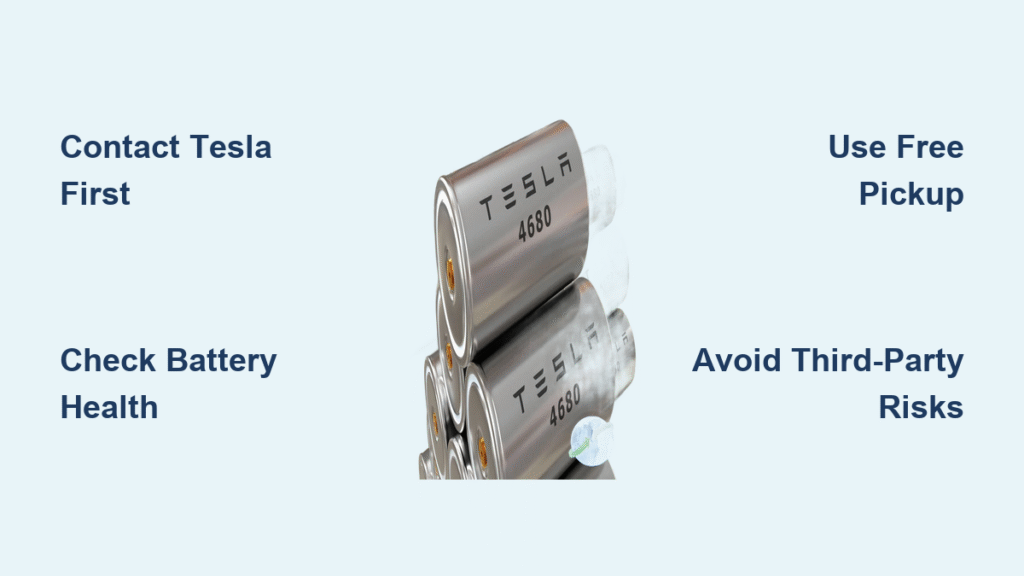
Your Tesla’s battery will likely outlast your car’s body by years—most packs deliver 300,000-500,000 miles before retirement. But when that day comes, you face a 900-pound dilemma: lithium-ion batteries can’t be tossed like old tires. The good news? Tesla’s recycling program handles 100% of materials at zero cost to you, turning dead batteries into tomorrow’s clean energy storage. Forget landfills or hidden fees—this guide cuts through the confusion with precise steps to legally and safely recycle your Tesla battery while protecting your investment.
Unlike junkyard scrap, EV batteries require specialized handling due to their volatile chemistry. Yet 95% of your pack’s valuable metals—nickel, cobalt, lithium—can be recovered for new batteries. You’ll learn exactly when recycling becomes necessary, how Tesla’s mandatory evaluation process works, and what happens during the 4-phase industrial recovery. Most importantly, you’ll avoid the #1 mistake owners make: attempting third-party recycling before contacting Tesla.
When Your Tesla Battery Actually Needs Recycling
Mileage and Degradation Red Flags
Don’t jump to conclusions when your range drops. Tesla batteries typically serve 8-10 years (or 300,000-500,000 miles) before true end-of-life. Your warranty covers 8 years/100,000-150,000 miles depending on model, but many packs function beyond that. Watch for these irreversible signs:
– Range loss exceeding 20% below original EPA rating (e.g., 300-mile Model S dropping below 240 miles)
– Persistent charging errors like “Service High Voltage Battery” warnings after software updates
– Overnight drain losing 10%+ charge while parked
– Charging speed collapse where superchargers take 2x longer than before
Pro Tip: Check your battery health via Tesla app → Controls → Service → Battery. If capacity shows ≤ 70%, recycling may be imminent.
What Accelerates Battery Death
Your habits directly impact longevity. Avoid these degradation boosters:
– Daily supercharging (limits battery cycles by 30%)
– Habitual deep discharges (driving below 10% regularly)
– Parking in extreme heat (Arizona owners see 15% faster degradation)
– Storing at 100% charge for weeks during vacations
Critical Warning: Never ignore swelling or hissing sounds—these indicate thermal runaway risk. Immediately contact Tesla if you notice bulging panels or chemical odors.
Tesla’s Mandatory First Step: The Evaluation Gatekeeper
Why You Must Call Tesla First
Skipping this step voids your recycling eligibility. Tesla’s priority is extending your battery’s life through repair—not recycling. Their engineers can often restore capacity via:
– Remote software recalibration (fixes 30% of “failing” batteries)
– Individual module swaps (costing 40% less than full replacement)
– Cloud diagnostics identifying faulty sensors mimicking battery failure
Contact channels that actually work:
– U.S./Canada: 1-877-79TESLA (bypass automated menus by saying “battery recycling”)
– Tesla app: Service → Request Service → Battery → “Battery Replacement”
– Web form: Submit at Tesla’s sustainability portal (not standard service requests)
Owner Insight: Service centers book evaluations 1-2 weeks out. Have your VIN, odometer reading, and battery health screenshots ready to avoid delays.
Your Zero-Cost Recycling Pathway
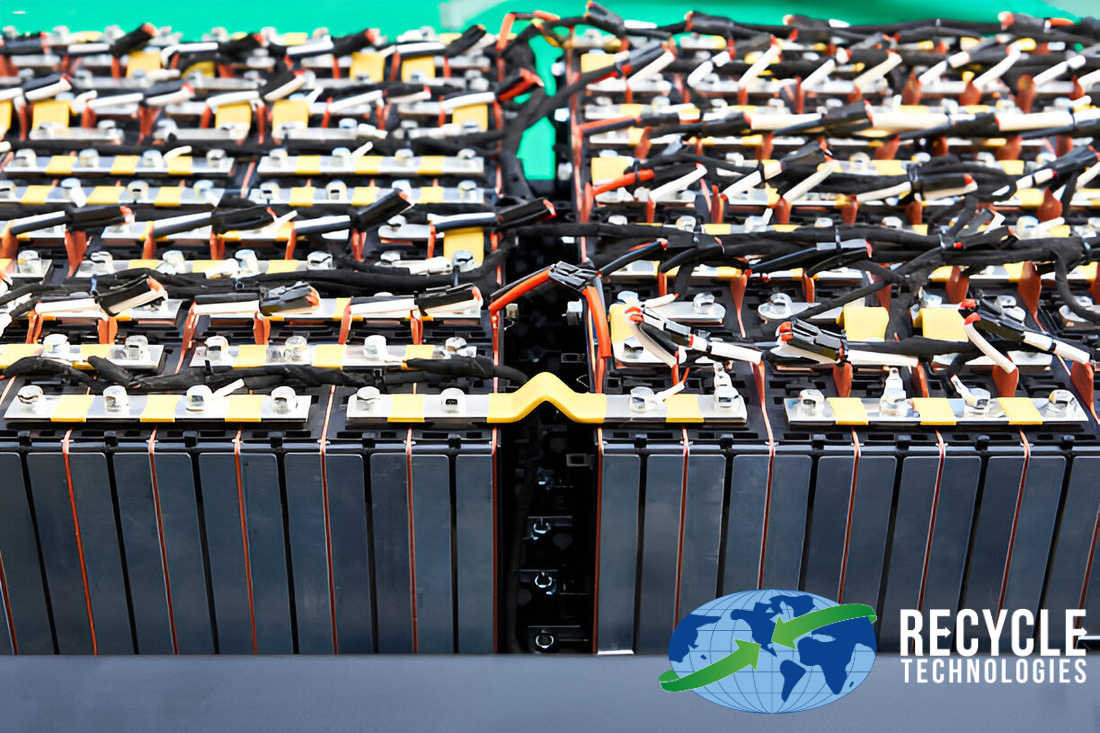
Tesla’s Free Pickup & Processing
If recycling is approved, Tesla handles everything:
– No out-of-pocket costs (they absorb ~$6,750 per battery)
– Doorstep pickup via certified hazardous-material carriers
– Full traceability with VIN-linked recycling certificates
– 1-3 week timeline from approval to completion
What Tesla won’t tell you: Most consumer batteries aren’t recycled yet—current volumes (like 2021’s 300 tons of copper recovery) come from warranty replacements. But your pack will join this stream as demand scales.
Third-Party Options If Tesla Declines
Rarely, Tesla may refuse recycling if your battery is repairable. In that case:
1. Redwood Materials: Free pickup via their portal (founded by Tesla’s ex-CTO)
2. ERI: Drop off at Best Buy (uses Redwood for processing)
3. Kinsbursky Brothers: R2-certified processors in MN/WI
Avoid these mistakes:
– ❌ Shipping batteries via FedEx/UPS (illegal without DOT certification)
– ❌ Selling to scrap yards (they landfill hazardous components)
– ❌ Storing packs in garages (fire risk if damaged)
The 4-Phase Recycling Process Decoded

Phase 1: Safe Extraction (15-30 Minutes)
What you’ll see at service centers:
1. Technicians discharge the pack below 30V (safe handling threshold)
2. They record VIN/serial numbers for material tracking
3. X-ray inspection checks for cell swelling or damage
4. Hydraulic lifts remove the pack—never attempt DIY extraction
Phase 2: Dismantling for Maximum Recovery
At facilities like Redwood’s Nevada plants:
– Module separation: High-voltage cables disconnected first
– Cell sorting: NCA (Tesla) vs. NCM chemistries separated
– 10% direct reuse: Aluminum casings and copper busbars salvaged intact
– Critical step: BMS boards shredded immediately for data security
Phase 3: Black Mass Creation

This is where magic happens:
1. Shredders reduce modules to <2mm particles (“black mass”)
2. Magnets pull steel; water baths separate plastics
3. Room-temperature acid leaching dissolves metals (new 2024 method)
4. Solvent extraction isolates lithium, cobalt, nickel streams
Pro Insight: 92% of lithium and 95% of cobalt gets recovered—enough for 9,000 Model Y batteries from 2021’s haul.
Your Action Plan: Do This Today
Immediate Checklist
- Call Tesla—not your local mechanic—using dedicated channels
- Document battery health via app screenshots (critical for evaluation)
- Prepare vehicle for pickup:
– Charge to 30-50% (safest transport level)
– Remove all personal items from frunk/trunk
– Disable Sentry Mode to prevent phantom drain - Verify recycler certifications if using third-party (look for R2/e-Stewards logos)
Cost Reality Check
| Service | Your Cost | Timeline |
|---|---|---|
| Tesla recycling | $0 | 1-3 weeks |
| Third-party | $0-$500 | 1-2 weeks |
| Remanufactured swap | $6,995+ | 1-4 weeks |
Warning: “Battery buyback” scams offering $2,000+ are fraudulent—Tesla never pays owners.
Future-Proofing Your Decision
Why Timing Matters Now
By 2030, 11 million EV batteries will reach end-of-life globally. Tesla’s 2030 vision includes:
– 50%+ recycled content in new batteries
– Closed-loop manufacturing at Gigafactories
– Cost parity with mined materials (current lithium carbonate: $20,000/ton)
Owner Advantage: Recycling today supports infrastructure that will slash future battery costs.
What to Ask Tesla’s Service Advisor
- “Will I receive a recycling certificate for insurance compliance?” (Yes)
- “Can I keep the battery for off-grid projects?” (Rarely—Tesla retains ownership)
- “What’s the timeline if I need immediate disposal?” (48-hour emergency protocols exist for damaged packs)
Final Reality Check: Recycling your Tesla battery isn’t disposal—it’s closing the loop on clean energy. With Tesla covering all costs and recovering 95% of materials, your “dead” pack becomes the foundation for future batteries. The single non-negotiable rule? Always contact Tesla first. Do that, follow the preparation steps, and you’ll transform a 900-pound problem into your contribution to the circular economy—all while protecting your wallet and the planet. The next time your range drops, remember: this battery’s journey isn’t over. It’s just beginning its second life.