
Your Toyota Prius suddenly drops from 50 MPG to 40 MPG, and you notice sluggish acceleration when pulling away from stoplights. These subtle performance changes often signal your hybrid battery pack is degrading—but how do you confirm it before facing a $3,000 surprise repair bill? This guide walks you through every method to accurately check your Toyota hybrid battery health, from free visual inspections to professional diagnostics. By monitoring your battery’s condition regularly, you’ll maintain optimal fuel efficiency and prevent unexpected breakdowns while extending your vehicle’s service life.
Identify Critical Dashboard Warning Patterns
Your Toyota communicates battery health through specific indicator lights that require immediate attention when illuminated. The red triangle or battery symbols indicate serious issues needing professional assessment, while yellow check engine lights often relate to battery management systems. These warning patterns provide your first clue about potential battery problems before performance noticeably declines.
Decoding Battery Warning Light Behavior
- Solid red battery icon: Signifies complete charging system failure requiring immediate service
- Flashing battery symbol: Indicates temperature management issues affecting battery performance
- Check engine light with battery icon: Signals hybrid system communication errors between components
Pro tip: Document when and how long warning lights stay illuminated. This information helps technicians diagnose intermittent issues that may not register during standard diagnostics.
Performance Changes That Signal Battery Issues
Track these subtle symptoms over two weeks to establish a pattern:
– Acceleration lag: Electric motor assistance feels weaker when merging or climbing hills
– Engine cycling: Gas engine activates more frequently at low speeds where electric power should dominate
– Fan noise: Battery cooling fan runs longer than usual after parking or during normal operation
Warning: Never ignore persistent warning lights. A degraded hybrid battery puts additional strain on your conventional engine, potentially causing cascading mechanical problems throughout your vehicle.
Execute Accurate DIY Battery Health Checks

Before spending money on professional diagnostics, perform these simple tests that reveal 80% of common hybrid battery issues using equipment you likely already own.
Track Fuel Economy Changes Methodically
Create an accurate baseline over 3 full tanks of gas to detect subtle degradation:
1. Fill tank completely and reset your trip meter
2. Drive normally for the entire tank without changing driving habits
3. Record miles driven and actual gallons used
4. Calculate MPG manually (miles ÷ gallons) for accuracy
5. Compare results to EPA ratings and your historical averages
Red flag threshold: A consistent drop of 15% or more from your normal MPG indicates significant battery degradation requiring further investigation.
Perform OBD-II Scanner Battery Analysis
Most Toyota hybrids from 2004+ have accessible diagnostic ports revealing critical battery metrics:
Required tools:
– OBD-II scanner compatible with Toyota hybrid systems ($50-200)
– Vehicle owner’s manual for port location specifics
Step-by-step scanning process:
1. Locate the OBD-II port under your dashboard (driver’s side, typically above pedals)
2. Connect scanner with key in “ON” position but engine off
3. Navigate to “Battery ECU” or “Hybrid System” menu
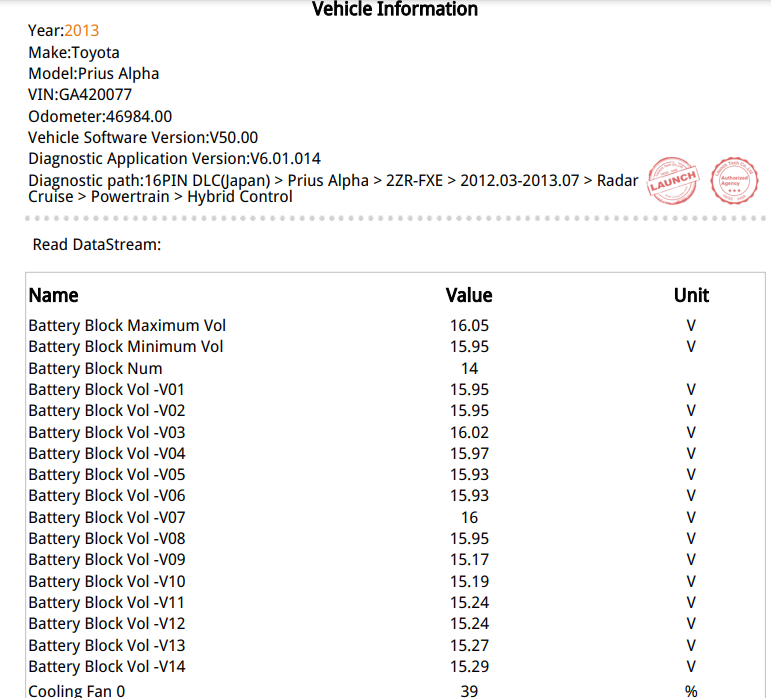
4. Record these critical values:
– State of Charge (SoC): Should consistently read 40-80% during normal operation
– Battery voltage: Healthy range is 200-280V across the pack
– Module voltage differences: Variations under 0.3V between modules indicate good health
Critical warning: Any module reading 0.5V+ different from others signals failing cells requiring professional attention.
Schedule Professional Diagnostic Testing When Needed
When DIY methods suggest problems, certified Toyota technicians use advanced equipment for precise battery analysis that consumer scanners can’t match.
Dealer Battery Health Assessment Process
Technicians perform these specialized tests during a professional evaluation:
– Individual module voltage testing under load conditions
– Internal resistance calculations to identify weak cells
– Overall pack capacity percentage determination
– Weak cell mapping to pinpoint exact problem locations
Typical results format includes:
– Battery health percentage (replacement recommended under 70%)
– Specific module voltage readings compared to specifications
– Technician recommendation for cell replacement or full pack service
Evaluate Diagnostic Cost Versus Value
Before authorizing the $100-150 diagnostic fee at a dealership, consider these factors:
Worth the diagnostic cost when:
– Your vehicle has 80,000+ miles and shows multiple symptoms
– DIY tests confirm concerning results
– You plan to keep the vehicle for 2+ years
Skip professional diagnostics when:
– Vehicle has fewer than 50,000 miles (likely covered under warranty)
– No noticeable symptoms or fuel economy changes exist
– You’re planning to sell the vehicle soon (disclose issues instead)
Conduct Thorough Physical Battery Inspection
Your hybrid battery resides behind the rear seats—perform these checks without special tools to catch developing problems early.
Complete Visual Inspection Checklist
Monthly examination should include:
– Vent blockages: Clear leaves or debris from battery cooling vents (typically located in rear side panels)
– Corrosion signs: Look for white or green buildup on orange high-voltage cables
– Physical damage: Check for cracked battery cases or loose mounting brackets
Expert note: Always disconnect the 12V battery before performing any visual inspection of hybrid components to prevent accidental electrical discharge.
Verify Cooling System Functionality
The battery’s thermal management system directly impacts longevity:
Fan operation test procedure:
1. Park vehicle and turn off engine
2. Listen for cooling fan operation 5-10 minutes after shutdown
3. Normal operation: Fan runs 2-5 minutes then stops completely
4. Problem indicator: Fan runs continuously for 10+ minutes or cycles frequently
Filter maintenance requirements:
– Location: Behind rear passenger wheel well on most Toyota hybrid models
– Cleaning frequency: Every 15,000 miles or quarterly in dusty environments
– Recommended method: Use compressed air or vacuum from outside vent only
Understand Realistic Battery Lifespan Expectations

Knowing normal degradation patterns helps you plan for eventual service without unnecessary panic.
Actual Toyota Hybrid Battery Life Cycles
Typical operational ranges:
– 8-10 years in moderate temperature climates
– 100,000-150,000 miles under normal driving conditions
– 5-7 years in regions with extreme hot or cold temperatures
– 15+ years possible with exceptional maintenance and favorable conditions
Analyze Replacement Cost Scenarios
Prepare financially with these realistic service options:
– Individual cell replacement: $500-1,500 (typically requires 12-20 cells)
– Refurbished complete battery pack: $1,500-3,000
– New OEM battery: $3,000-5,000+ (varies significantly by model)
Money-saving strategy: Independent hybrid specialists often charge 30-50% less than dealerships for identical battery service work while using the same quality parts.
Implement Proactive Battery Maintenance Practices
These simple habits significantly extend your hybrid battery’s service life and maintain optimal performance.
Optimize Cooling System Maintenance
Quarterly essential tasks:
– Vacuum battery air intake vents to prevent blockages
– Check for rodent nests or debris accumulation near vents
– Ensure cargo area vents remain unobstructed by luggage or accessories
Annual professional service should include:
– Deep cleaning of the entire cooling system
– Replacement of cabin air filter (indirectly affects battery cooling)
– Verification of refrigerant levels in plug-in hybrid models
Adopt Battery-Friendly Driving Habits
Daily practices that matter:
– Avoid full-throttle acceleration from stops that stresses the battery
– Limit use of “B” mode on shifter (increases battery heat during regenerative braking)
– Park in shade during hot weather to reduce thermal stress
– Never let fuel tank run completely empty (triggers battery protection mode)
Temperature management techniques:
– Pre-cool cabin while plugged in (for plug-in hybrid models)
– Use remote start feature in extreme weather before driving
– Garage parking adds 2-3 years to battery life in temperature-controlled environments
Follow This Emergency Diagnostic Decision Tree
Use this flowchart when symptoms appear for immediate action guidance:
Experiencing performance issues?
→ Check MPG: Drop exceeding 15%? → Perform OBD-II scan immediately
→ Warning lights illuminated? → Schedule professional diagnostic immediately
→ No lights, normal MPG? → Continue quarterly monitoring
Scanner results interpretation:
– Module voltage variation exceeding 0.5V → Professional evaluation required within 2 weeks
– Overall health percentage below 70% → Consider replacement options
– All metrics within normal range → Continue standard monitoring schedule
Recognize When Immediate Professional Help Is Critical
Don’t delay service if you experience:
– Complete loss of electric assist power during normal driving
– Battery overheating warnings on your dashboard display
– Strange chemical smells emanating from the rear seat area
– Vehicle entering “limp mode” with drastically reduced power
Safe to continue driving short-term with monitoring:
– Minor MPG decrease (under 10% from normal)
– Intermittent warning lights that disappear after restart
– Normal acceleration with occasional minor hiccups
Key takeaway: Your Toyota hybrid battery typically provides clear warning signs months before complete failure. By combining monthly visual inspections, quarterly fuel economy tracking, and semi-annual OBD-II scans, you can predict problems early—potentially saving thousands through planned replacement rather than emergency service.
Next steps: Start with fuel economy tracking this week, then invest in a basic OBD-II scanner ($50-100) for regular health checks. This proactive approach typically extends battery life by 2-3 years while maintaining peak performance throughout your ownership, maximizing your hybrid’s legendary fuel efficiency and reliability.


